
Gene Expression Versus Collagen Accumulation in GHK-Cu Research: A Technical Analysis
Gene-expression changes and collagen accumulation are distinct endpoints in GHK-Cu (glycyl-L-histidyl-L-lysine copper complex) research. This article examines why gene expression data do not directly equate to measurable collagen deposition, drawing on in vitro, animal, and gene array studies. Evidence limitations and mechanistic uncertainties are discussed.

Direct Answer: Why Gene-Expression Changes Are Not the Same as Collagen Accumulation in GHK-Cu Research
Gene-expression changes, such as increased mRNA levels for collagen genes, represent molecular signals that may initiate or regulate protein synthesis. Collagen accumulation, by contrast, is a measurable endpoint reflecting the net deposition of collagen protein in tissue. In GHK-Cu research, gene expression changes do not always translate directly into increased collagen accumulation due to multiple regulatory, translational, and post-translational processes. This distinction is supported by both in vitro and in vivo studies, which show that while GHK-Cu can upregulate collagen gene expression, actual collagen accumulation depends on additional cellular and extracellular factors, and the relationship between mRNA and protein levels is not always linear or predictable Source 1 Source 2.
Introduction: Defining the Entities and the Research Question
GHK-Cu (glycyl-L-histidyl-L-lysine copper complex) is a tripeptide-copper complex studied for its effects on tissue repair, extracellular matrix (ECM) remodeling, and gene regulation. Research on GHK-Cu spans in vitro cell culture, animal wound models, and gene expression profiling. A recurring theme is the observation that GHK-Cu can modulate gene expression, including upregulation of collagen mRNAs. However, the translation of these molecular changes into functional tissue outcomes—such as increased collagen deposition—remains a complex, multi-step process. This article explores the mechanistic and experimental reasons why gene-expression changes are not synonymous with collagen accumulation in the context of GHK-Cu research.
Mechanistic Distinction: From Gene Expression to Protein Accumulation
Gene expression refers to the process by which information encoded in DNA is transcribed into messenger RNA (mRNA), which can then be translated into proteins. In the context of collagen, increased mRNA levels for type I or type III collagen suggest that the cell is primed to synthesize more collagen protein. However, several regulatory layers exist between mRNA production and protein accumulation:
- Translational Regulation: Not all mRNAs are efficiently translated into protein. Factors such as ribosome availability, microRNAs, and RNA-binding proteins can modulate translation rates.
- Post-Translational Modifications: Collagen proteins undergo extensive modifications (e.g., hydroxylation, glycosylation, triple-helix formation) before they are secreted and incorporated into the ECM.
- Protein Stability and Degradation: Newly synthesized collagen can be degraded by proteases or fail to be properly cross-linked, reducing net accumulation.
- Extracellular Assembly: Collagen must be secreted and assembled into fibrils within the ECM, a process influenced by other matrix components and enzymes.
Thus, while gene expression changes are necessary for increased protein synthesis, they are not sufficient to guarantee increased protein accumulation Source 2.
Evidence from In Vitro and Animal Models: GHK-Cu Effects on Collagen
In Vitro Findings
Early studies demonstrated that GHK-Cu can stimulate collagen synthesis in cultured fibroblasts, as measured by increased incorporation of radiolabeled proline into collagenase-sensitive proteins. These studies also reported upregulation of collagen mRNA, indicating transcriptional activation Source 2. However, in vitro systems lack the full complexity of tissue environments, and the translation of mRNA increases to protein accumulation can be more direct than in vivo.
Animal Model Findings
A pivotal in vivo study used a rat wound chamber model to assess the effects of GHK-Cu on tissue repair Source 1. Rats received GHK-Cu injections into subcutaneous wound chambers, and outcomes included:
- Increased Collagen mRNA: Both type I and type III collagen mRNAs were elevated in GHK-Cu-treated wounds.
- Increased Collagen Accumulation: Collagen content, measured biochemically, was also increased, but the magnitude and timing of mRNA and protein changes were not identical.
- Nonlinear Relationship: The stimulation of collagen synthesis was approximately twice that of non-collagen proteins, but the relationship between mRNA and protein accumulation was not strictly proportional.
This study illustrates that while GHK-Cu can drive both gene expression and protein accumulation, the two endpoints are related but not equivalent.
Experimental Approaches: Measuring Gene Expression Versus Collagen Accumulation
Gene Expression Assays
- RT-PCR and Northern Blot: Quantify mRNA levels for specific collagen genes.
- Microarray and RNA-Seq: Provide global gene expression profiles, including collagen and ECM-related genes.
These assays measure the transcriptional response to GHK-Cu but do not provide direct information about protein levels or tissue structure.
Collagen Accumulation Assays
- Biochemical Quantification: Hydroxyproline assays and colorimetric methods measure total collagen content in tissue extracts.
- Histological Staining: Sirius Red or Masson's Trichrome stains visualize collagen fibers in tissue sections.
- Immunohistochemistry: Detects specific collagen types using antibodies.
These methods assess the net result of synthesis, secretion, assembly, and degradation of collagen proteins.
Key Point
Gene expression assays are sensitive to early molecular changes, while collagen accumulation assays reflect the integrated outcome of multiple biological processes over time Source 1.
Regulatory and Contextual Factors Affecting Collagen Accumulation
Several factors can modulate the translation of gene expression changes into collagen accumulation:
- Growth Factors and Cytokines: Transforming growth factor-beta (TGF-β) and other cytokines can influence both transcription and post-transcriptional events.
- Matrix Metalloproteinases (MMPs): These enzymes degrade collagen and can counteract increased synthesis.
- Cellular Stress and Inflammation: Oxidative stress, inflammation, and other microenvironmental factors can alter protein stability and ECM remodeling.
- Temporal Dynamics: mRNA increases may precede protein accumulation by hours to days, and protein turnover rates vary.
In the cited rat wound model, GHK-Cu increased collagen mRNA without affecting TGF-β mRNA, suggesting a degree of pathway specificity Source 1.
Comparative Table: Gene Expression vs. Collagen Accumulation in GHK-Cu Research
| Endpoint | What It Measures | GHK-Cu Effect (Animal Model) | Limitations |
|---|---|---|---|
| Collagen mRNA | Transcriptional activity | Increased | May not predict protein |
| Collagen protein | Net tissue accumulation | Increased | Influenced by degradation |
| Collagen fiber assembly | Structural ECM organization | Not always directly measured | Requires histology |
Note: The relationship between mRNA and protein is not strictly linear; protein accumulation depends on multiple downstream processes.
Evidence Limitations and Uncertainties
- Model Systems: Most GHK-Cu research on collagen has been conducted in animal models or cell cultures, which may not fully recapitulate human tissue biology.
- Temporal Disconnect: mRNA and protein measurements are often taken at different time points, complicating direct comparisons.
- Complex Regulation: Post-transcriptional, translational, and post-translational controls can decouple gene expression from protein accumulation.
- Lack of Human Data: There is a paucity of controlled human studies directly linking GHK-Cu-induced gene expression changes to measurable increases in collagen deposition in vivo.
- Assay Sensitivity: Biochemical and histological assays for collagen have variable sensitivity and specificity, potentially affecting outcome interpretation.
Key Takeaways and Research Gaps
- Gene expression changes are an early and necessary step in protein synthesis but do not guarantee increased protein accumulation.
- Collagen accumulation is a complex endpoint influenced by synthesis, modification, secretion, degradation, and assembly.
- GHK-Cu has been shown to increase both collagen mRNA and protein in animal models, but the relationship is not strictly proportional or predictable.
- Further research is needed to clarify the mechanisms linking gene expression to functional tissue outcomes, especially in human systems.
- Caution is warranted in extrapolating gene expression data to claims about tissue regeneration or clinical efficacy.
Incidental Product Mention (Research-Only)
Products such as GHKCU 100 MG and GHKCU 2MG 60 CAPSULES are available for laboratory and research use only. These products are not intended for human or veterinary use, and their mention here does not imply suitability for clinical or personal application.
Conclusion
In summary, gene-expression changes and collagen accumulation are related but distinct endpoints in GHK-Cu research. While GHK-Cu can upregulate collagen gene expression and promote collagen accumulation in animal models, the translation from mRNA to protein is regulated by multiple biological processes. Evidence from in vitro and animal studies supports a role for GHK-Cu in stimulating both endpoints, but the relationship is not linear or guaranteed. Limitations in current evidence, particularly the lack of controlled human studies, underscore the need for caution in interpreting gene expression data as direct evidence of tissue regeneration or clinical benefit.
For research and educational purposes only. Not medical advice. Research products are not for human or veterinary use.
Sources
- In vivo stimulation of connective tissue accumulation by the tripeptide-copper complex glycyl-L-histidyl-L-lysine-Cu2+ in rat experimental wounds - https://pmc.ncbi.nlm.nih.gov/articles/PMC288419/
- The Effect of the Human Peptide GHK on Gene Expression Relevant to Nervous System Function and Cognitive Decline - https://pmc.ncbi.nlm.nih.gov/articles/PMC5332963/
Continue exploring
TRACE THE EVIDENCE
Sources & further reading
RELATED PRODUCT INFORMATION
From the Certified Pep catalog.
Product references are informational, not a recommendation for human use. Prices and availability must be verified at retailer checkout.
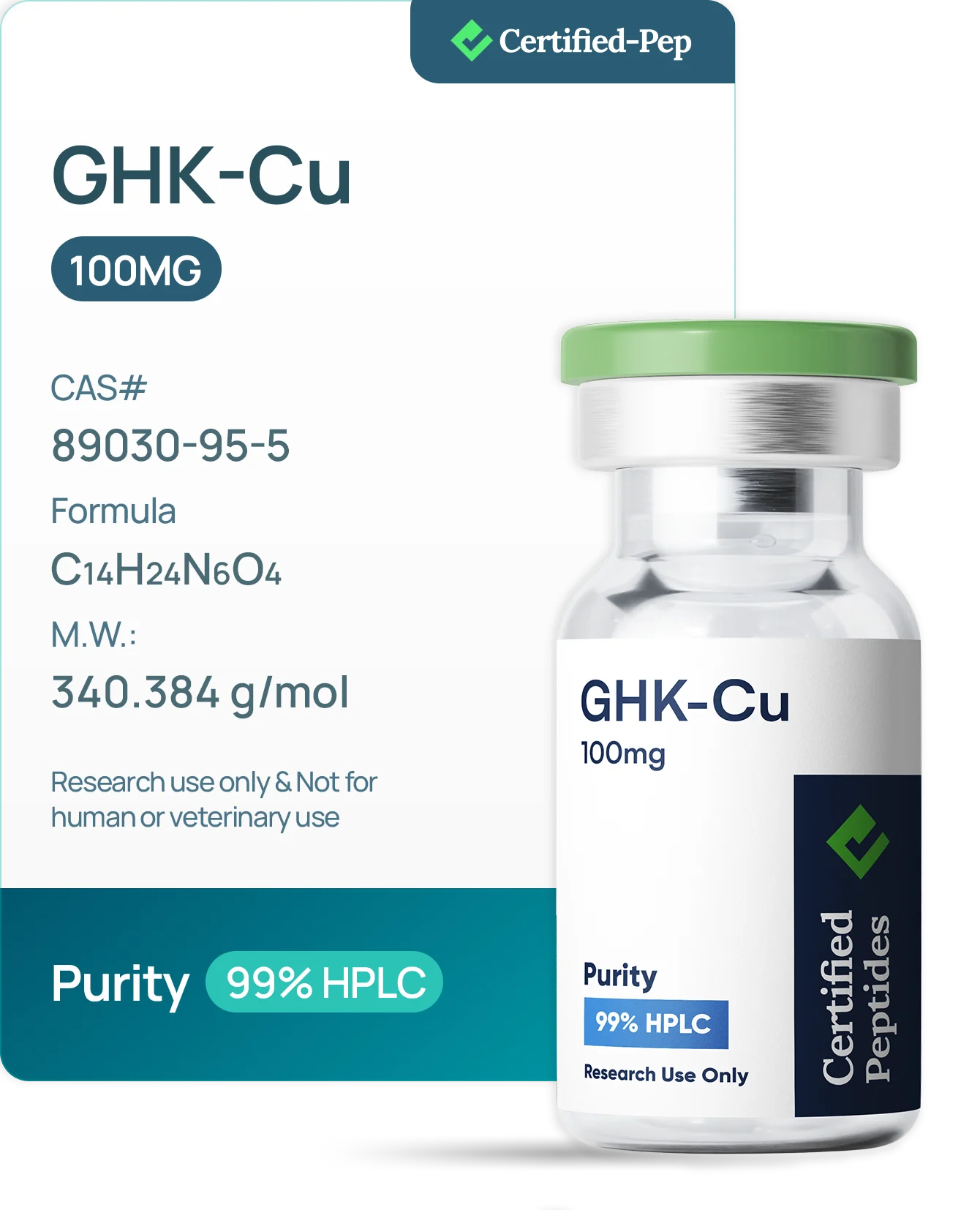
GHKCU 100 MG
USD 59.00
In stock
Last synced: 2026-11-01 10:07
Add to retailer cart ↗View product details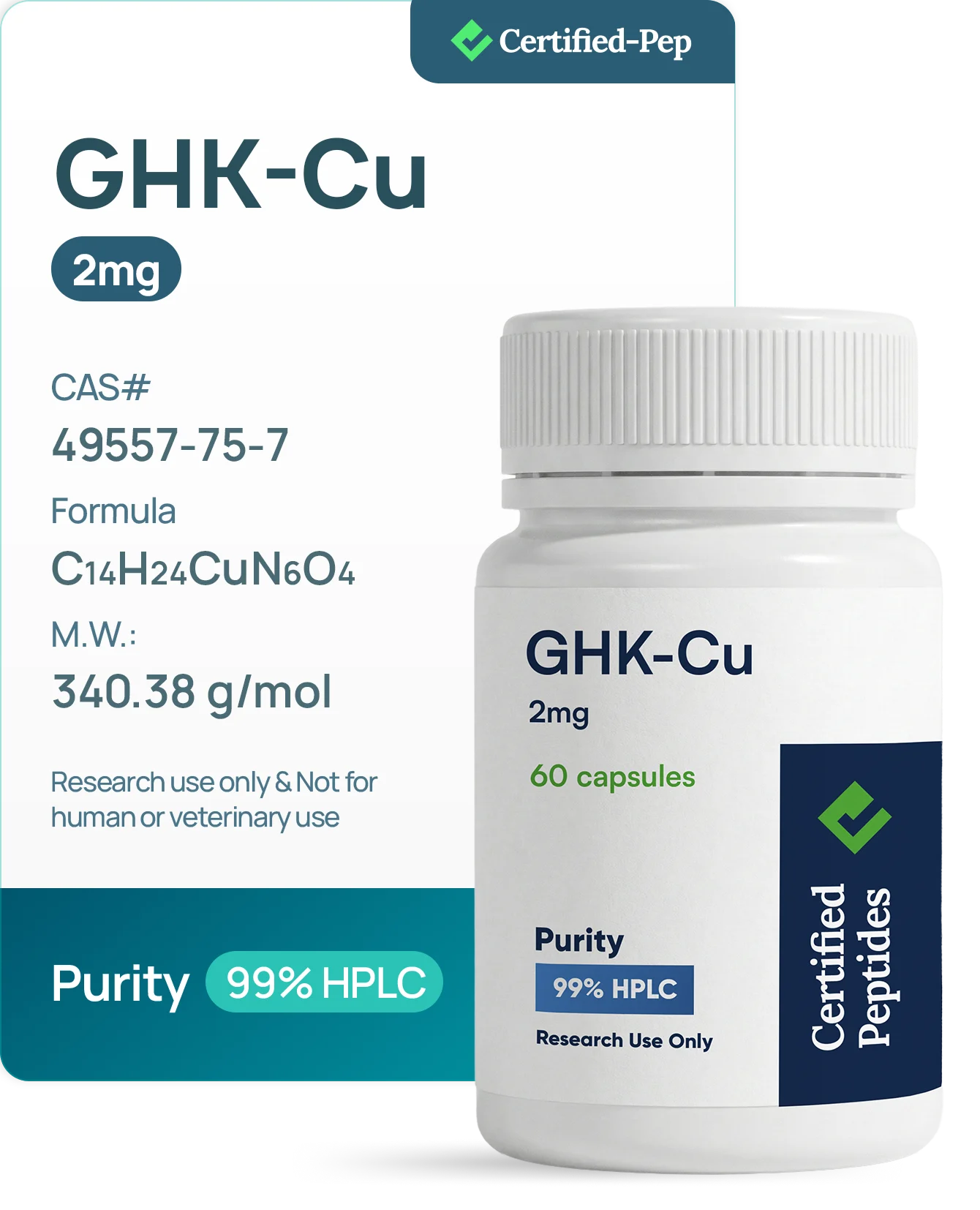
GHK-CU 2MG 60 CAPSULES
USD 198.00 USD 160.00
In stock
Last synced: 2026-11-01 10:07
Add to retailer cart ↗View product details
SELANK 10 MG
USD 50.00
In stock
Last synced: 2026-11-01 10:07
Add to retailer cart ↗View product details
THYMOSIN ALPHA-1 10MG
USD 78.00
In stock
Last synced: 2026-11-01 10:07
Add to retailer cart ↗View product details
SEMAX 10MG
USD 54.00
In stock
Last synced: 2026-11-01 10:07
Add to retailer cart ↗View product details