
Elevated Plus Maze Endpoints in Selank Rat Studies: Research Interpretation
The elevated plus maze (EPM) is a validated behavioral assay for assessing anxiety-like behaviors in rodents. In Selank rat studies, EPM endpoints—such as time spent in open versus closed arms—serve as quantitative measures of anxiety, not direct clinical outcomes. This article reviews the experimental design, measured endpoints, and interpretation of EPM data in the context of Selank research, emphasizing methodological strengths, limitations, and the boundaries of preclinical inference.

Introduction: The Elevated Plus Maze in Peptide Research
The elevated plus maze (EPM) is a widely used behavioral test in rodent models to assess anxiety-like behaviors. It consists of two open arms and two closed arms elevated above the floor. Rodents naturally avoid open, elevated spaces due to their aversion to potential threats, so time spent in open arms is inversely related to anxiety levels. In peptide research, including studies of the synthetic peptide Selank, the EPM provides a standardized endpoint for quantifying changes in anxiety-related behavior following experimental interventions.
This article examines what the EPM endpoint measures in the context of Selank rat studies, focusing on the experimental design, behavioral endpoints, and the interpretation of findings. The discussion is strictly limited to reported research and does not infer clinical efficacy or safety.
Defining the Elevated Plus Maze Endpoint
The primary endpoints in the EPM are the time spent in open arms, time spent in closed arms, number of entries into each arm type, and additional behaviors such as rearing or hanging from open arms. These quantitative measures are interpreted as proxies for anxiety-like behavior: increased time in open arms and more frequent entries are typically considered indicative of reduced anxiety, while increased time in closed arms suggests heightened anxiety.
In the cited Selank rat study, the EPM was used to evaluate the anxiolytic (anxiety-reducing) activity of Selank, diazepam (a classical benzodiazepine), and their combination under both baseline and unpredictable chronic mild stress (UCMS) conditions. The endpoints measured included: - Time spent in open arms (seconds) - Time spent in closed arms (seconds) - Number of hanging events from open arms - Number of squares crossed (locomotor activity) - Number of rears (vertical exploration)
These endpoints were recorded before and after a 14-day administration of test substances, with or without UCMS exposure Source 2.
Experimental Design: Selank and the EPM in Rats
The referenced study employed male Wistar rats divided into groups exposed to either standard conditions or UCMS, a protocol designed to induce chronic stress and elevate anxiety levels. Each group received one of the following treatments for 14 days: - Saline (control) - Selank - Diazepam (DZ) - Selank + Diazepam
Behavioral testing using the EPM occurred before and after the treatment period. The EPM apparatus consisted of a central platform with four arms (two open, two closed), and each rat was placed in the center facing an open arm. The test lasted three minutes, during which the aforementioned endpoints were recorded using video tracking and analysis software Source 2.
Interpretation of EPM Endpoints: Anxiety-Related Behavior
The EPM endpoints are interpreted as follows: - Time in open arms: Increased time is associated with reduced anxiety-like behavior. - Time in closed arms: Increased time suggests heightened anxiety. - Number of open arm entries/hanging events: More frequent entries or hanging events indicate lower anxiety. - Locomotor activity (squares crossed): Assesses general activity; significant changes may confound anxiety interpretation if not controlled.
In the Selank rat study, administration of saline, Selank, DZ, or their combination led to changes in these endpoints. Notably, under UCMS, rats treated with saline showed a marked reduction in open arm time (indicative of increased anxiety), while those treated with Selank, DZ, or both exhibited less pronounced reductions or even improvements in open arm time, suggesting an anxiolytic effect in this preclinical model Source 2.
Key Findings from the Selank Rat EPM Study
Baseline (No Chronic Stress)
- All treatments, including saline, led to a reduction in open arm time over 14 days, interpreted as increased anxiety, possibly due to the stress of repeated handling or administration.
- The reduction in open arm time was least pronounced in the Selank group, suggesting a potential anxiolytic-like effect relative to controls.
- Locomotor activity was largely unchanged in the Selank group, indicating that changes in open arm time were not due to sedation or motor impairment.
Unpredictable Chronic Mild Stress (UCMS)
- Saline-treated rats under UCMS showed a dramatic reduction in open arm time and increased closed arm time, consistent with elevated anxiety.
- Selank, DZ, and especially their combination mitigated these changes, with the combination group showing open arm times similar to pre-stress levels.
- The combination of Selank and DZ produced the most robust effect in maintaining open arm time and reducing closed arm time, compared to either agent alone.
These results suggest that, in this rat model, EPM endpoints are sensitive to both stress-induced anxiety and the effects of anxiolytic interventions Source 2.
Methodological Strengths and Controls
The study employed several methodological strengths: - Randomization and group assignment: Rats were randomly assigned to treatment and control groups. - Repeated measures: Behavioral endpoints were recorded before and after intervention, allowing within-subject comparisons. - UCMS protocol: The use of a validated chronic stress model increased the relevance of findings to anxiety research. - Multiple endpoints: Both anxiety-related and locomotor activity measures were recorded to distinguish anxiolytic effects from nonspecific sedation or hyperactivity.
Statistical analyses included nonparametric tests for dependent and independent samples, with significance set at α < 0.05 Source 2.
Limitations and Uncertainties in EPM Interpretation
Despite its widespread use, the EPM has several limitations: - Species and strain differences: Behavioral responses can vary between rodent strains and species, limiting generalizability. - Environmental factors: Lighting, noise, and prior handling can influence EPM performance. - Locomotor confounds: Agents that alter general activity may affect EPM endpoints independently of anxiety. - Interpretation boundaries: The EPM measures anxiety-like behavior, not clinical anxiety or psychiatric disorders. Findings in rodents do not directly translate to human therapeutic effects. - Single time point: The study measured behavior at only two time points (pre- and post-intervention), which may not capture dynamic changes or long-term effects.
The cited study also notes that repeated administration of any substance, including saline, increased anxiety-like behavior, suggesting that procedural stress may confound results Source 2.
Contextualizing EPM Findings in Selank Research
The EPM is one of several behavioral assays used to assess the effects of Selank in preclinical models. Other studies have examined gene expression changes related to GABAergic neurotransmission and interactions with classical anxiolytics Source 1. However, the EPM remains a primary endpoint for quantifying observable behavioral changes in response to experimental interventions.
It is important to emphasize that EPM endpoints are proxies for anxiety-like behavior in rodents and do not constitute evidence of clinical efficacy, safety, or regulatory approval for Selank or any peptide. The findings are specific to the experimental conditions and cannot be extrapolated to human populations without further controlled studies.
Unresolved Questions and Future Directions
Several questions remain open in the interpretation of EPM endpoints in Selank research: - Mechanistic specificity: While EPM changes suggest anxiolytic-like effects, the precise molecular mechanisms by which Selank influences behavior remain under investigation. Evidence suggests modulation of GABAergic signaling, but direct receptor interactions are not fully established Source 1. - Dose-response relationships: The optimal dosing and administration route for maximal behavioral effects in rodents require further study. - Long-term effects: The persistence of EPM changes after cessation of treatment is not well characterized. - Translation to other models: Replication in different strains, species, and with alternative anxiety assays would strengthen the evidence base.
Evidence Limitations and Key Takeaways
- The EPM endpoint in Selank rat studies measures anxiety-like behavior, operationalized as time spent in open versus closed arms and related behaviors.
- Findings are limited to preclinical rodent models and do not imply clinical efficacy or safety in humans.
- Procedural and environmental factors, as well as potential confounding effects on locomotion, must be carefully controlled and interpreted.
- The cited study provides evidence that Selank, alone or in combination with diazepam, can modulate EPM endpoints under stress conditions in rats, but these results are not directly translatable to clinical practice.
For research and educational purposes only. Not medical advice. Research products are not for human or veterinary use.
Sources
- GABA, Selank, and Olanzapine Affect the Expression of Genes Involved in GABAergic Neurotransmission in IMR-32 Cells - PMC. https://pmc.ncbi.nlm.nih.gov/articles/PMC5328971/
- Peptide Selank Enhances the Effect of Diazepam in Reducing Anxiety in Unpredictable Chronic Mild Stress Conditions in Rats - PMC. https://pmc.ncbi.nlm.nih.gov/articles/PMC5322660/
Continue exploring
- Interpreting Ascorbate Consumption in the Semax–Copper–Amyloid-β In Vitro Study
- Distinguishing Proposed and Established Thymosin Alpha-1 Applications: An Evidence-Based Approach
- Epithelial-Mesenchymal Transition and Fibrosis Markers in the Epitalon Retinal In Vitro Study: Technical Insights and Evidence Limitations
TRACE THE EVIDENCE
Sources & further reading
RELATED PRODUCT INFORMATION
From the Certified Pep catalog.
Product references are informational, not a recommendation for human use. Prices and availability must be verified at retailer checkout.
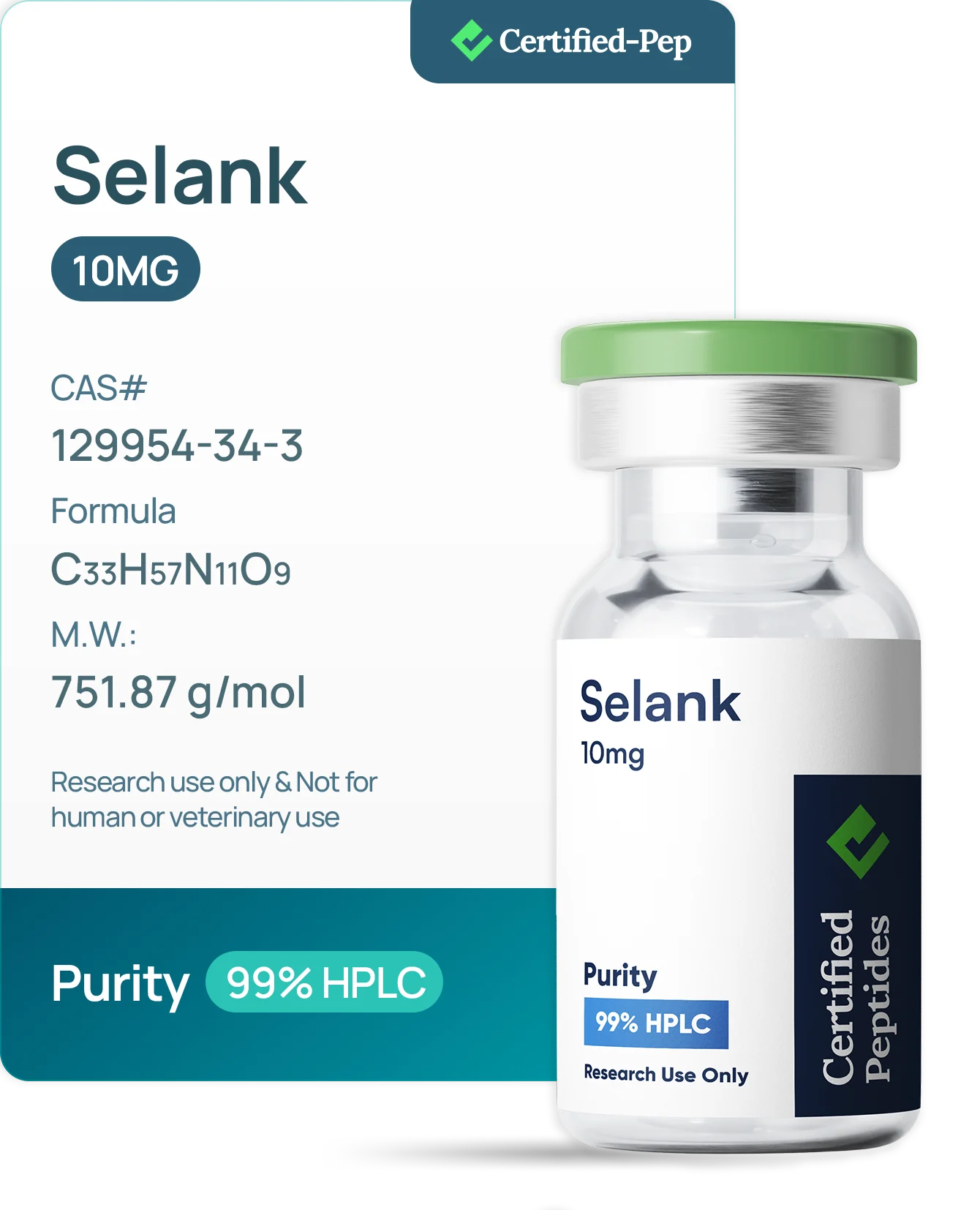
SELANK 10 MG
USD 50.00
In stock
Last synced: 2026-11-01 10:07
Add to retailer cart ↗View product details
THYMOSIN ALPHA-1 10MG
USD 78.00
In stock
Last synced: 2026-11-01 10:07
Add to retailer cart ↗View product details
SEMAX 10MG
USD 54.00
In stock
Last synced: 2026-11-01 10:07
Add to retailer cart ↗View product details