
Interpreting Ascorbate Consumption in the Semax–Copper–Amyloid-β In Vitro Study
This article examines what ascorbate consumption measures in the context of a key in vitro study on Semax, copper, and amyloid-β, and highlights the method's strengths and limitations for peptide research interpretation.

Introduction: Ascorbate Consumption as a Research Endpoint
In peptide research, especially studies investigating metal-catalyzed oxidative stress, the consumption of ascorbate (vitamin C) is frequently used as an indirect measure of redox activity and reactive oxygen species (ROS) generation. This approach is central to a recent in vitro study examining the peptide Semax and its interaction with copper ions and amyloid-β (Aβ) peptides, which are implicated in Alzheimer’s disease pathology. Understanding what ascorbate consumption reveals—and what it does not—about peptide–metal–protein interactions is essential for interpreting such research and for designing further experiments Source 1.
Defining the Experimental System: Semax, Copper, and Amyloid-β
Semax (Met-Glu-His-Phe-Pro-Gly-Pro) is a synthetic peptide with a high affinity for copper(II) ions, featuring an ATCUN (Amino Terminal Cu(II) and Ni(II) binding) motif. The cited study investigates Semax’s ability to chelate copper, disrupt copper–Aβ complexes, and modulate copper-catalyzed ROS production in vitro. The experimental system uses: - Purified Aβ peptides (Aβ1–16, Aβ1–28, Aβ1–40) - Copper(II) ions - Ascorbate as a physiological reducing agent - Semax peptide
ROS generation is monitored by two main readouts: the rate of ascorbate consumption (via UV absorbance at 265 nm) and the formation of hydroxyl radicals (via fluorescence of 7-hydroxycoumarin-3-carboxylate, a product of 3-CCA oxidation) Source 1.
What Does Ascorbate Consumption Measure?
Mechanistic Basis
Ascorbate acts as a sacrificial electron donor in redox reactions catalyzed by copper ions. In the presence of copper(II), ascorbate is oxidized to dehydroascorbate, reducing Cu(II) to Cu(I). The reduced copper can then participate in Fenton-like reactions, generating ROS such as hydroxyl radicals. Thus, the rate of ascorbate consumption provides an indirect index of the redox cycling activity of copper species in the system Source 1.
Experimental Readout
- High ascorbate consumption: Indicates active redox cycling, with copper catalyzing electron transfer from ascorbate to molecular oxygen, generating ROS.
- Reduced ascorbate consumption: Suggests inhibition of copper redox cycling, possibly due to chelation (e.g., by Semax) or sequestration of copper in redox-inactive complexes.
In the cited study, ascorbate consumption is used to compare the redox activity of free copper, copper–Aβ complexes, and copper chelated by Semax. The presence of Semax markedly reduces ascorbate consumption, indicating that Semax forms a redox-inert complex with copper(II), thereby silencing copper’s catalytic activity in ROS production Source 1.
What Does Ascorbate Consumption Miss?
Indirectness and Specificity
While ascorbate consumption is a useful proxy for redox cycling, it does not directly measure ROS species or their biological effects. Several limitations are inherent to this approach: - Non-specificity: Ascorbate can be consumed by other redox-active species or side reactions not involving copper or Aβ. - Lack of spatial resolution: The assay does not reveal where ROS are generated or whether they interact with specific biomolecules. - No direct measure of oxidative damage: Ascorbate consumption does not quantify oxidative modifications to proteins, lipids, or DNA.
Kinetic and Thermodynamic Complexity
The method is sensitive to the kinetics of complex formation and redox reactions. For example, if copper reduction by ascorbate is faster than Semax–Cu(II) complex formation, some copper may escape chelation and participate in ROS-generating cycles. This was observed in the study, where a small but significant ascorbate consumption persisted even in the presence of Semax, attributed to kinetic competition between reduction and chelation Source 1.
Biological Relevance
The ascorbate consumption assay is performed in vitro, under controlled buffer conditions, and may not reflect the complexity of cellular or tissue environments. Factors such as compartmentalization, competing ligands, and antioxidant systems are not modeled.
Interpreting the Study’s Findings: Context and Controls
Key Results
- Free Cu(II): Rapid and complete ascorbate consumption, high ROS production.
- Cu(II) + Aβ: Reduced ascorbate consumption and ROS generation compared to free copper, due to formation of Aβ–Cu(II) complexes with lower redox activity.
- Cu(II) + Semax: Markedly inhibited ascorbate consumption and ROS generation, indicating redox silencing by Semax–Cu(II) complex formation.
- Cu(II) + Aβ + Semax: Semax can extract copper from Aβ–Cu(II) complexes, further reducing ascorbate consumption and ROS production.
Experimental Controls
The study uses several controls to validate the specificity of ascorbate consumption as a readout: - Ascorbate alone (no copper): Stable over time, confirming that spontaneous oxidation is negligible. - Cu(II) alone: Maximal ascorbate consumption, establishing the catalytic baseline. - Aβ fragments: Comparable results across Aβ1–16, Aβ1–28, and Aβ1–40, supporting the generalizability of the findings.
Complementary Assays
To address the limitations of ascorbate consumption, the study also measures hydroxyl radical production (via 3-CCA fluorescence) and performs cell-based assays (ROS detection by H2DCFDA staining and cell viability by MTT assay) in SH-SY5Y neuroblastoma cells. These provide more direct evidence of ROS generation and cytotoxicity, but remain in vitro Source 1.
Methodological Limitations and Uncertainties
In Vitro Constraints
- Buffer conditions: The experiments are conducted in phosphate buffer at pH 7.4, which may not fully replicate physiological ionic strength, pH, or the presence of competing biomolecules.
- Concentration ranges: The peptide, copper, and ascorbate concentrations may not match those found in vivo, and their ratios can influence reaction kinetics and equilibria.
- Absence of cellular context: While some cell-based assays are included, the primary ascorbate consumption measurements are performed in cell-free systems.
Kinetic vs. Thermodynamic Control
The study highlights that the outcome of ascorbate consumption depends on the relative rates of copper reduction and peptide–metal complex formation. If ascorbate reduces Cu(II) to Cu(I) before Semax can chelate it, some redox cycling and ROS generation may occur despite the presence of a high-affinity chelator. This kinetic competition is not always predictable and may differ in more complex biological systems Source 1.
Indirectness of the Readout
Ascorbate consumption is an indirect measure of ROS-generating activity. It does not distinguish between different ROS species, nor does it provide information about downstream oxidative damage or signaling effects. The method is best interpreted in conjunction with more direct ROS and cell viability assays.
Practical Checklist for Reading Peptide–Metal Redox Studies
- What is being measured?
- Is ascorbate consumption used as a proxy for redox cycling or ROS production?
- What are the controls?
- Are free metal, peptide–metal, and chelator–metal complexes compared?
- Are complementary assays included?
- Is ROS production measured directly (e.g., via fluorescence probes)?
- Are cell-based assays performed?
- What are the kinetic and thermodynamic considerations?
- Are rates of reduction and complex formation discussed?
- What are the limitations?
- Is the system in vitro or in cells?
- Are physiological concentrations and conditions modeled?
- What is not measured?
- Is there direct evidence of oxidative damage or functional outcomes?
Reader Questions and Research Gaps
- Does ascorbate consumption always correlate with ROS-mediated cytotoxicity in cells?
- How do kinetic factors (e.g., order of addition, mixing rates) influence the outcome?
- Can ascorbate consumption distinguish between different types of ROS or redox-active metal complexes?
- What additional assays would strengthen the mechanistic conclusions?
Evidence Limitations and Key Takeaways
Evidence Boundaries
- The cited study is an in vitro investigation using purified peptides, copper ions, and ascorbate in buffered solutions, supplemented by cell culture assays in SH-SY5Y neuroblastoma cells.
- Findings are limited to the specific experimental conditions and do not establish efficacy, safety, or therapeutic potential in humans or animals.
- Ascorbate consumption is an indirect, context-dependent measure of redox activity and should be interpreted alongside direct ROS and cytotoxicity assays.
Key Takeaways
- Ascorbate consumption in the Semax–copper–Aβ study measures the redox cycling activity of copper species and their ability to catalyze ROS production.
- The method is valuable for comparing the redox-silencing effects of chelators like Semax, but does not directly measure ROS species, oxidative damage, or biological outcomes.
- Kinetic competition between copper reduction and chelation can limit the effectiveness of redox silencing, even with high-affinity peptides.
- The approach is best used as part of a broader experimental toolkit, including direct ROS detection and cell-based assays, to build a more complete picture of peptide–metal interactions.
Conclusion
Ascorbate consumption is a widely used, but indirect, measure of redox cycling and ROS generation in peptide–metal research. In the context of the Semax–copper–Aβ in vitro study, it provides important mechanistic insights into how Semax chelates copper and inhibits copper-catalyzed oxidative reactions. However, the method’s limitations—including its indirectness, sensitivity to kinetic factors, and lack of biological specificity—underscore the need for complementary assays and cautious interpretation. These findings are research-focused and do not imply clinical efficacy or safety.
For research and educational purposes only. Not medical advice. Research products are not for human or veterinary use.
Sources
- Semax, a Copper Chelator Peptide, Decreases the Cu(II)-Catalyzed ROS Production and Cytotoxicity of aβ by Metal Ion Stripping and Redox Silencing. https://pmc.ncbi.nlm.nih.gov/articles/PMC12151629/
Continue exploring
- Distinguishing Proposed and Established Thymosin Alpha-1 Applications: An Evidence-Based Approach
- Epithelial-Mesenchymal Transition and Fibrosis Markers in the Epitalon Retinal In Vitro Study: Technical Insights and Evidence Limitations
- Understanding Limits of Detection and Quantification in TB-500 Peptide Research
TRACE THE EVIDENCE
Sources & further reading
RELATED PRODUCT INFORMATION
From the Certified Pep catalog.
Product references are informational, not a recommendation for human use. Prices and availability must be verified at retailer checkout.
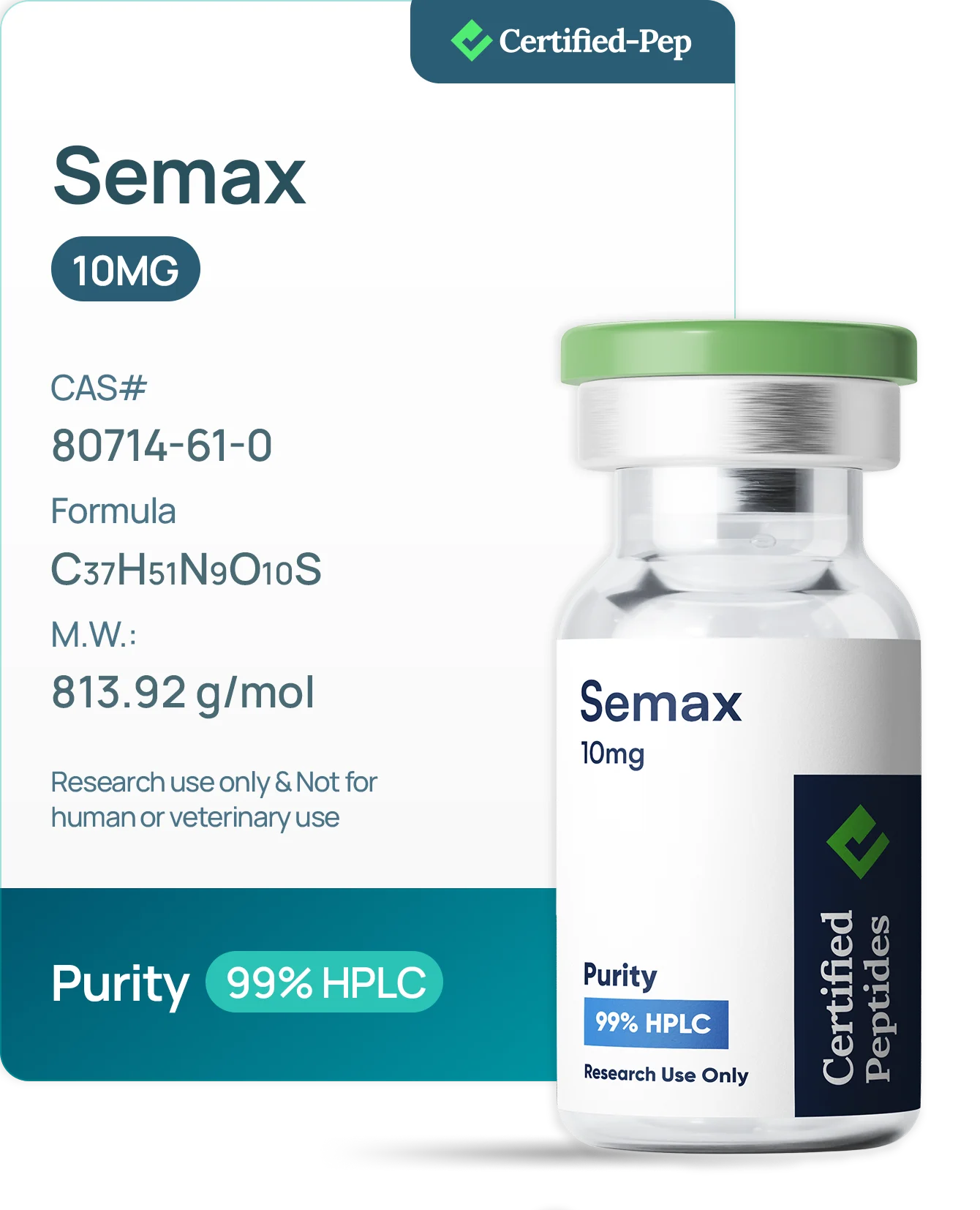
SEMAX 10MG
USD 54.00
In stock
Last synced: 2026-11-01 10:07
Add to retailer cart ↗View product details
TB-500 10 MG
USD 70.00
In stock
Last synced: 2026-11-01 10:07
Add to retailer cart ↗View product details
THYMOSIN ALPHA-1 10MG
USD 78.00
In stock
Last synced: 2026-11-01 10:07
Add to retailer cart ↗View product details