
Interpreting Semax Oxidative-Stress Assays: Why Multiple Experimental Readouts Matter
Semax oxidative-stress research employs multiple experimental readouts to robustly characterize its effects on reactive oxygen species (ROS) production, metal chelation, and cytotoxicity. This article explains the rationale for such assay design, details the specific endpoints used in a recent in-vitro and cell-based study, and discusses the strengths and limitations of this approach for peptide research interpretation.

Introduction: The Role of Multiplexed Assays in Peptide Oxidative-Stress Research
In peptide research, particularly studies investigating oxidative stress, the use of multiple experimental readouts is a methodological cornerstone. This approach is exemplified in recent investigations of Semax—a synthetic peptide with high copper-binding affinity—where researchers have sought to elucidate its effects on copper-catalyzed reactive oxygen species (ROS) production and associated cytotoxicity. Understanding why more than one readout is employed is essential for critically interpreting the evidence, appreciating the complexity of oxidative-stress mechanisms, and recognizing the boundaries of preclinical findings.
This article provides a detailed, evidence-based exploration of the rationale and implementation of multiplexed assays in Semax oxidative-stress research. It draws exclusively on a recent in-vitro and cell-based study, clarifies the endpoints measured, and discusses the interpretive value and limitations of such experimental designs Source 1.
Defining Key Concepts: Semax, Oxidative Stress, and Experimental Readouts
Semax is a synthetic regulatory peptide derived from the adrenocorticotropic hormone (ACTH) fragment (Met-Glu-His-Phe-Pro-Gly-Pro). It is notable for its high affinity for copper(II) ions, attributed to its amino-terminal copper and nickel (ATCUN) binding motif. In research contexts, Semax is investigated for its potential to modulate metal-catalyzed oxidative processes, particularly those implicated in neurodegenerative disease models Source 1.
Oxidative stress refers to the imbalance between the production of ROS—such as superoxide, hydrogen peroxide, and hydroxyl radicals—and the capacity of biological systems to detoxify these reactive intermediates. In the context of Alzheimer’s disease (AD) models, copper ions bound to amyloid-β (Aβ) peptides can catalyze ROS generation, contributing to neuronal damage.
Experimental readouts are the measurable endpoints or outputs of an assay. In oxidative-stress research, these may include direct chemical measurements (e.g., ROS quantification), indirect biochemical markers (e.g., ascorbate consumption), and biological outcomes (e.g., cell viability). Employing multiple readouts allows researchers to triangulate findings, control for confounding variables, and build a more comprehensive mechanistic picture.
Why Use Multiple Experimental Readouts? The Rationale in Peptide Oxidative-Stress Assays
Addressing Mechanistic Complexity
Oxidative stress is a multifaceted process involving numerous interacting pathways. Single readouts may capture only a fragment of this complexity. For example, measuring ROS levels alone does not distinguish between different ROS species or reveal upstream events such as metal chelation or redox cycling. By combining chemical, biochemical, and cellular endpoints, researchers can:
- Dissect Mechanisms: Distinguish between direct ROS scavenging, metal chelation, and inhibition of redox cycling.
- Validate Findings: Cross-validate results across independent assay types, reducing the risk of artifactual or assay-specific effects.
- Control for Confounders: Identify off-target or non-specific effects that might not be apparent in a single assay.
Enhancing Interpretive Confidence
Multiple readouts provide converging lines of evidence, strengthening the interpretive confidence in observed effects. For instance, if Semax reduces both ROS production (chemical assay) and cell death (biological assay), this supports a link between its chemical activity and biological outcome, though it does not establish causality in humans Source 1.
Reader Questions
- How do different readouts complement each other in oxidative-stress research?
- What are the risks of relying on a single assay endpoint?
- How do researchers ensure that observed effects are specific to the peptide under investigation?
Experimental Models and Readouts Used in Semax Oxidative-Stress Research
A recent study investigating Semax’s effects on copper-catalyzed ROS production and cytotoxicity employed a suite of in-vitro and cell-based assays. The main experimental readouts included:
1. Ascorbate Consumption (UV-Absorbance Measurement)
- Principle: Ascorbate (vitamin C) is a physiological reducing agent that can be oxidized in the presence of redox-active metals, serving as an indirect marker of ROS-generating redox cycling.
- Implementation: The rate and extent of ascorbate consumption were monitored by UV absorbance at 265 nm. A decrease in absorbance indicates ascorbate oxidation, which is accelerated by copper-catalyzed ROS production.
- Interpretive Value: This readout provides a kinetic and quantitative measure of redox cycling activity, but does not directly specify which ROS are produced Source 1.
2. Hydroxyl Radical Detection (3-CCA Fluorescence Assay)
- Principle: The non-fluorescent probe coumarin-3-carboxylic acid (3-CCA) reacts with hydroxyl radicals (•OH) to form a fluorescent product (7-hydroxycoumarin-3-carboxylate).
- Implementation: Fluorescence intensity at 450 nm (excitation at 395 nm) was measured over time. Increased fluorescence indicates hydroxyl radical generation.
- Interpretive Value: This assay provides specificity for hydroxyl radicals, a particularly reactive and damaging ROS, complementing the broader ascorbate consumption assay Source 1.
3. UV-Visible Spectroscopy (Metal-Peptide Complex Formation)
- Principle: UV-Vis spectroscopy can detect changes in absorbance associated with the formation or disruption of metal-peptide complexes.
- Implementation: Shifts in absorbance bands were used to monitor the binding of copper to Semax or Aβ, and the displacement of copper from Aβ by Semax.
- Interpretive Value: This readout provides mechanistic insight into the chelation process, supporting the hypothesis that Semax can extract copper from Aβ and form a redox-inert complex Source 1.
4. Cellular ROS Production (Flow Cytometry with H2DCFDA Staining)
- Principle: The cell-permeable probe H2DCFDA is hydrolyzed and oxidized within cells to form fluorescent DCF, indicating intracellular ROS levels.
- Implementation: Human neuroblastoma SH-SY5Y cells were exposed to copper, ascorbate, and Aβ, with or without Semax. Flow cytometry quantified the proportion of cells with elevated ROS.
- Interpretive Value: This assay translates chemical findings into a cellular context, demonstrating whether Semax’s effects on ROS are observed in living cells Source 1.
5. Cell Viability (MTT Assay)
- Principle: The MTT assay measures the reduction of a tetrazolium salt to formazan by cellular reductases, serving as an indicator of metabolic activity and viability.
- Implementation: SH-SY5Y cells were treated as above, and cell viability was quantified after 24 hours.
- Interpretive Value: This endpoint assesses the biological consequence of oxidative stress and its modulation by Semax, linking chemical events to cell survival Source 1.
How Multiple Readouts Inform Mechanistic Interpretation
Triangulating Mechanisms
By integrating these readouts, researchers can:
- Link Metal Chelation to ROS Suppression: UV-Vis spectroscopy confirms Semax’s ability to bind copper, while ascorbate consumption and 3-CCA fluorescence show reduced ROS generation in the presence of Semax.
- Connect Chemical Events to Biological Outcomes: Reduced ROS in chemical assays is paralleled by decreased intracellular ROS and improved cell viability in SH-SY5Y cells.
- Dissect Kinetic vs. Thermodynamic Effects: The study found that while Semax forms a highly stable copper complex, complete inhibition of ROS production was not always achieved, likely due to kinetic factors in copper reduction and complex formation. This nuance would be missed with a single endpoint Source 1.
Controlling for Confounding Factors
- Specificity: By using both chemical and biological assays, the study could distinguish between direct chemical effects (e.g., copper chelation) and non-specific toxicity or off-target effects.
- Reversibility and Competition: Sequential addition experiments (e.g., adding Semax after Aβ-copper complex formation) clarified whether Semax could extract copper from preformed complexes, a detail not accessible from a single assay.
Methodological Strengths and Limitations
Strengths
- Robustness: Multiple, independent endpoints reduce the likelihood that findings are due to assay artifacts or experimental error.
- Mechanistic Depth: The combination of chemical, spectroscopic, and cellular assays enables a more nuanced mechanistic understanding.
- Translational Relevance: Cell-based assays provide a bridge between in-vitro chemistry and potential biological effects, though they do not establish clinical efficacy or safety.
Limitations
- Model Constraints: All findings are from in-vitro and cell culture models. These systems do not replicate the complexity of living organisms, and results may not translate to animal or human contexts.
- Endpoint Specificity: Some assays (e.g., ascorbate consumption) are indirect and may be influenced by factors other than ROS production.
- Temporal Resolution: Kinetic differences in complex formation and redox cycling may complicate interpretation, as seen in the partial inhibition of ROS despite high-affinity copper binding.
- No Clinical Inference: The study does not provide evidence for safety, efficacy, or therapeutic benefit in humans or animals.
Practical Checklist for Reading Peptide Oxidative-Stress Assays
- Identify the Experimental Models: Are the assays in-vitro, cell-based, or in-vivo?
- List the Readouts: What endpoints are measured (chemical, spectroscopic, biological)?
- Assess Complementarity: How do the readouts inform each other? Do they address different aspects of the mechanism?
- Check Controls: Are appropriate negative and positive controls included?
- Evaluate Limitations: Are the endpoints direct or indirect? What confounding factors might influence results?
- Avoid Over-Interpretation: Do not infer clinical relevance from preclinical findings unless explicitly supported by controlled human studies.
Evidence Limitations and Gaps
- Preclinical Scope: All data are from in-vitro and cell culture experiments; no animal or human studies are reported.
- Assay Artifacts: Some endpoints may be susceptible to interference from experimental conditions or reagent impurities.
- Mechanistic Uncertainty: While multiple readouts strengthen mechanistic hypotheses, they do not establish causality in complex biological systems.
- No Safety or Dosing Data: The study does not address pharmacokinetics, safety, or dosing in any organism.
Key Takeaways
- Multiple experimental readouts are essential in peptide oxidative-stress research to capture the complexity of ROS generation, metal chelation, and cytotoxicity.
- In the cited Semax study, a combination of chemical, spectroscopic, and cell-based assays provided a robust, multi-dimensional view of its effects on copper-catalyzed oxidative stress.
- While this approach strengthens mechanistic interpretation and controls for confounders, all findings are limited to preclinical models and do not imply safety or efficacy in humans or animals.
- Critical reading of such studies requires attention to model systems, assay endpoints, controls, and the boundaries of inference.
For research and educational purposes only. Not medical advice. Research products are not for human or veterinary use.
Sources
- Semax, a Copper Chelator Peptide, Decreases the Cu(II)-Catalyzed ROS Production and Cytotoxicity of aβ by Metal Ion Stripping and Redox Silencing. https://pmc.ncbi.nlm.nih.gov/articles/PMC12151629/
Continue exploring
- Interpreting Null Gene-Expression Findings in the Selank IMR-32 Cell Study: Evidence and Limitations
- Distinguishing Gastric-Emptying and Growth-Hormone Endpoints in Ipamorelin Research: Mechanistic and Methodological Considerations
- Why Scratch Closure in the Epitalon Retinal-Cell Model Is Not Evidence of Restored Vision
TRACE THE EVIDENCE
Sources & further reading
RELATED PRODUCT INFORMATION
From the Certified Pep catalog.
Product references are informational, not a recommendation for human use. Prices and availability must be verified at retailer checkout.
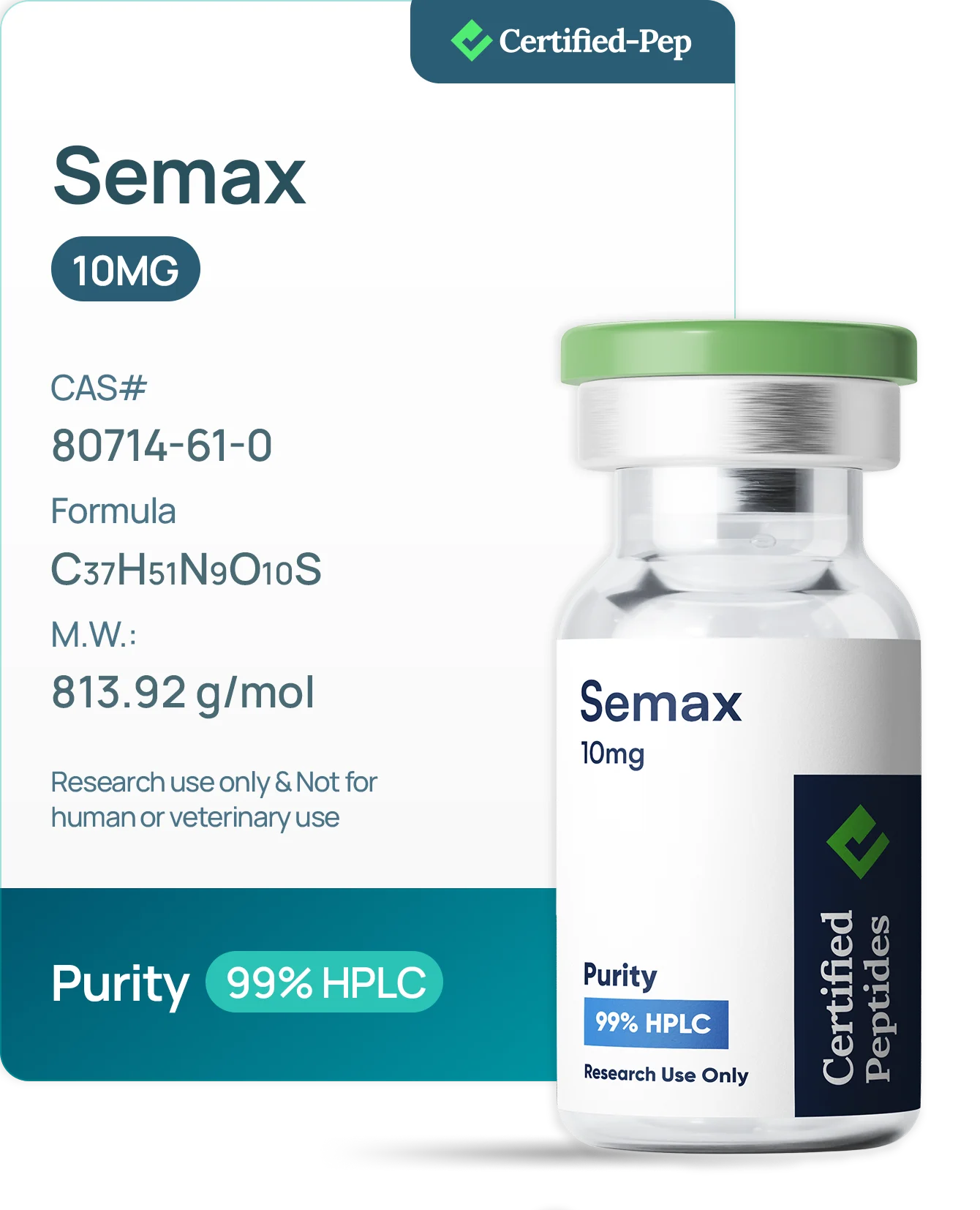
SEMAX 10MG
USD 54.00
In stock
Last synced: 2026-11-01 10:07
Add to retailer cart ↗View product details
SELANK 10 MG
USD 50.00
In stock
Last synced: 2026-11-01 10:07
Add to retailer cart ↗View product details
IPAMORELIN 10 MG
USD 67.00
In stock
Last synced: 2026-11-01 10:07
Add to retailer cart ↗View product details