
Interpreting Null Gene-Expression Findings in the Selank IMR-32 Cell Study: Evidence and Limitations
A detailed analysis of the 2017 Selank study in IMR-32 neuroblastoma cells, focusing on the interpretation of its null gene-expression results, the experimental context, and the implications for peptide research.

Direct Answer: How Should the Selank Study's Null Gene-Expression Findings Be Interpreted?
The 2017 study investigating Selank's effects on the expression of 84 genes involved in GABAergic neurotransmission in IMR-32 human neuroblastoma cells found that Selank, when administered alone, did not significantly alter the mRNA levels of any of the genes studied. This null result suggests that, under the specific experimental conditions and in this cell line, Selank does not directly regulate the transcription of these genes. However, the interpretation of these findings must consider the experimental model, methodological limitations, and broader context of peptide research. The absence of gene-expression changes does not preclude other molecular or functional effects, nor does it rule out context-dependent actions in other cell types, tissues, or in vivo systems. The findings are specific to the IMR-32 cell line and the acute exposure protocol used, and should not be generalized to infer clinical efficacy, safety, or mechanisms in humans.
For research and educational purposes only. Not medical advice. Research products are not for human or veterinary use.
Introduction: Selank and the GABAergic System
Selank is a synthetic peptide analog of the immunopeptide tuftsin, designed for enhanced metabolic stability and duration of action. It has been studied for its potential neuromodulatory and anxiolytic properties, with some clinical and preclinical evidence suggesting effects comparable to classical benzodiazepines, which act as positive allosteric modulators of GABA_A receptors. Given these observations, researchers have hypothesized that Selank may influence the GABAergic system at the molecular level, possibly by modulating gene expression or receptor function. The 2017 study by Filatova et al. aimed to test this hypothesis by examining Selank's impact on the expression of genes involved in GABAergic neurotransmission in a human neuroblastoma cell line (IMR-32) Source 1.
Experimental Design and Methods
The study utilized the IMR-32 cell line, a human neuroblastoma model known to express functional GABA_A receptors, albeit with a limited subunit composition. Researchers treated the cells with Selank, GABA (the primary endogenous ligand for GABA_A receptors), olanzapine (an atypical antipsychotic with some GABAergic effects), and combinations thereof. After a 1-hour incubation, they measured mRNA levels of 84 genes related to neurotransmission using quantitative PCR (qPCR), following MIQE guidelines for experimental rigor. Genes with low expression (Cq > 35) were excluded from analysis, leaving 69 genes for statistical evaluation. Changes were considered significant if mRNA levels changed by at least 1.5-fold with a p-value ≤ 0.05 Source 1.
Key Findings: Null Effects of Selank Alone
The central finding was that Selank, when administered alone to IMR-32 cells, did not produce statistically significant changes in the mRNA levels of any of the 69 genes analyzed. In contrast, GABA and olanzapine each induced changes in the expression of multiple genes, with GABA affecting 14 genes (mostly downregulation) and olanzapine affecting 25 genes. Notably, the combination of Selank and GABA suppressed most of the gene-expression changes induced by GABA alone, while the combination of Selank and olanzapine led to more pronounced and widespread changes than olanzapine alone Source 1.
Contextualizing the Null Result: Cell Line and Receptor Subunit Composition
The lack of gene-expression changes in response to Selank in IMR-32 cells may be attributable to the unique properties of this cell line. IMR-32 cells express a restricted set of GABA_A receptor subunits, with confirmed protein-level expression of α3, β1, β3, and γ2 subunits. The pharmacology of GABA_A receptors is highly dependent on their subunit composition, which determines their responsiveness to allosteric modulators such as benzodiazepines and potentially Selank. The study authors note that Selank may not interact effectively with the specific GABA_A receptor subtypes present in IMR-32 cells, limiting its ability to modulate gene expression in this context Source 1.
Comparison with Other Models and Previous Findings
Previous research has shown that Selank can alter gene expression in other systems. For example, in rodent models, Selank administration led to changes in the expression of genes involved in neurotransmission in the frontal cortex and hippocampus, as well as in immune-related genes in the spleen Source 1. These findings suggest that Selank's molecular effects may be context-dependent, varying with cell type, tissue, and species. The null result in IMR-32 cells underscores the importance of model selection in peptide research and cautions against overgeneralizing from a single experimental system.
Mechanistic Implications: Beyond Gene Expression
While the study found no direct transcriptional effects of Selank in IMR-32 cells, it does not exclude other mechanisms of action. Selank has been reported to modulate the binding affinity of GABA to GABA_A receptors in other experimental settings, possibly through allosteric modulation rather than transcriptional regulation. The suppression of GABA-induced gene-expression changes by Selank in the combination treatment suggests a potential modulatory effect at the receptor or signaling level, rather than at the level of gene transcription. These findings highlight the complexity of peptide-receptor interactions and the need for multifaceted approaches to elucidate mechanisms Source 1.
Methodological and Interpretive Limitations
Several limitations must be considered when interpreting the null gene-expression findings:
- Cell Line Specificity: IMR-32 cells are a transformed neuroblastoma line with limited receptor diversity and may not recapitulate the full spectrum of neuronal responses found in vivo.
- Acute Exposure: The 1-hour incubation may not capture delayed or cumulative transcriptional effects that could occur with longer or repeated exposure.
- Gene Panel: Only 69 genes were analyzed after filtering, potentially missing effects on other relevant genes or pathways.
- Transcription vs. Function: Absence of mRNA changes does not rule out post-transcriptional, translational, or functional modulation of receptors or signaling pathways.
- Lack of In Vivo Correlation: Results in cell culture may not translate to intact neural circuits or whole organisms.
The authors themselves caution that the absence of gene-expression changes in this model does not exclude other modes of action for Selank and that the findings are not necessarily generalizable to other systems Source 1.
Broader Research Context: Selank in Animal and Human Studies
While the IMR-32 study provides valuable mechanistic insight, it is only one piece of the broader research landscape. In animal models, Selank has demonstrated behavioral effects, such as reducing anxiety-like behaviors in rats, especially when combined with classical benzodiazepines like diazepam Source 2. These effects have been hypothesized to involve allosteric modulation of GABA_A receptors, but the precise molecular mechanisms remain under investigation. Some clinical studies have reported anxiolytic effects of Selank in humans, but these findings are not directly linked to gene-expression changes and are outside the scope of the IMR-32 cell study Source 2.
Unresolved Questions and Future Directions
The null gene-expression findings in IMR-32 cells raise several important questions for future research:
- Does Selank modulate GABAergic function through non-transcriptional mechanisms in certain cell types?
- Would different cell lines, primary neurons, or in vivo models reveal gene-expression changes not seen in IMR-32 cells?
- Are longer or repeated exposures necessary to detect transcriptional effects?
- How does receptor subunit composition influence Selank's molecular actions?
- What are the downstream signaling pathways involved in Selank's reported behavioral effects?
Addressing these questions will require integrated studies using diverse models, time courses, and molecular endpoints.
Evidence Limitations and Key Takeaways
- The 2017 IMR-32 cell study provides evidence that Selank does not directly alter the expression of a panel of GABAergic genes in this specific cell line under acute exposure conditions.
- The null result is model- and context-specific and does not exclude other molecular or functional effects of Selank in different systems.
- The findings highlight the importance of experimental context, receptor subunit composition, and methodological rigor in peptide research.
- Broader claims about Selank's mechanisms or clinical effects cannot be made based solely on this study.
- Further research is needed to clarify Selank's molecular actions, especially in physiologically relevant models.
For research and educational purposes only. Not medical advice. Research products are not for human or veterinary use.
Sources
- GABA, Selank, and Olanzapine Affect the Expression of Genes Involved in GABAergic Neurotransmission in IMR-32 Cells - PMC. https://pmc.ncbi.nlm.nih.gov/articles/PMC5328971/
- Peptide Selank Enhances the Effect of Diazepam in Reducing Anxiety in Unpredictable Chronic Mild Stress Conditions in Rats - PMC. https://pmc.ncbi.nlm.nih.gov/articles/PMC5322660/
Continue exploring
- Distinguishing Gastric-Emptying and Growth-Hormone Endpoints in Ipamorelin Research: Mechanistic and Methodological Considerations
- Why Scratch Closure in the Epitalon Retinal-Cell Model Is Not Evidence of Restored Vision
- Why Study Model and Biological Sample Selection Matter in TB-500 Analytical Research
TRACE THE EVIDENCE
Sources & further reading
RELATED PRODUCT INFORMATION
From the Certified Pep catalog.
Product references are informational, not a recommendation for human use. Prices and availability must be verified at retailer checkout.
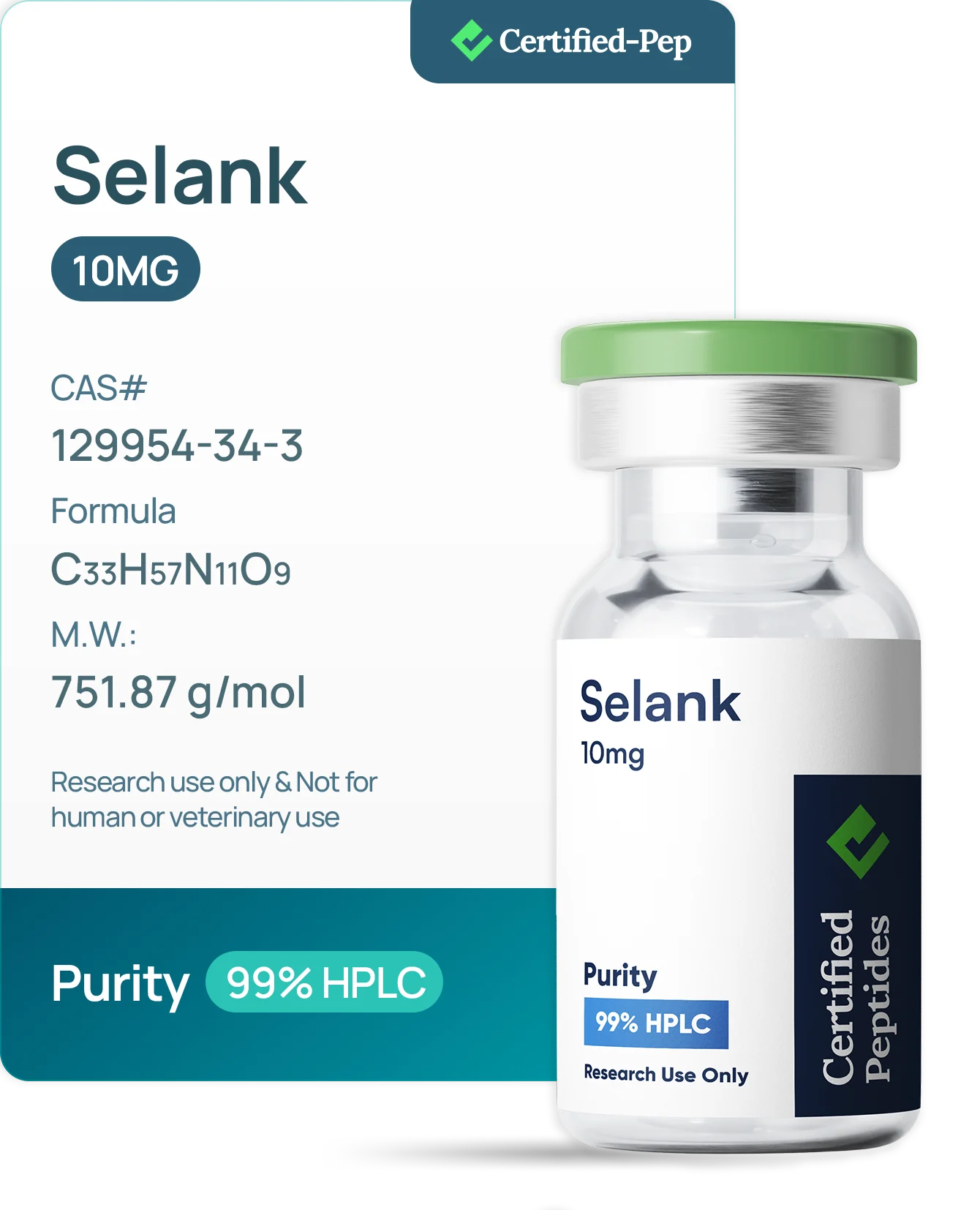
SELANK 10 MG
USD 50.00
In stock
Last synced: 2026-11-01 10:07
Add to retailer cart ↗View product details
IPAMORELIN 10 MG
USD 67.00
In stock
Last synced: 2026-11-01 10:07
Add to retailer cart ↗View product details
TB-500 10 MG
USD 70.00
In stock
Last synced: 2026-11-01 10:07
Add to retailer cart ↗View product details