
GHK vs. GHK-Cu: What Is the Difference?
Compare GHK and its copper complex, GHK-Cu. Learn what the cited laboratory and animal studies show, and why they do not establish human benefits.
Direct Comparison: GHK vs. GHK-Cu—What Is the Difference?
GHK (glycyl-L-histidyl-L-lysine) is a naturally occurring tripeptide, while GHK-Cu is its copper(II) complex. The two entities differ in their chemical structure, copper-binding capacity, and experimentally observed biological activities. Research indicates that many of GHK’s biological effects are potentiated or altered by copper binding, but the unbound peptide and the copper complex are not functionally identical. Experimental models show distinct effects for each, and mechanistic studies suggest copper chelation is critical for certain cellular responses. However, the precise boundaries between their independent and overlapping actions remain incompletely defined, and clinical implications are not established.
1. Defining GHK and GHK-Cu: Chemical and Biochemical Distinctions
GHK is a tripeptide composed of glycine, histidine, and lysine. It is found in human plasma and tissues, with concentrations declining with age. GHK has a high affinity for copper(II) ions, forming the GHK-Cu complex. The copper complexation alters the molecule’s charge, conformation, and biochemical reactivity. In plasma, GHK exists both as the free peptide and as GHK-Cu, but the ratio depends on copper availability and competing copper-binding proteins such as albumin Source 2.
GHK and GHK-Cu are distinct chemical entities: - GHK: Unbound tripeptide, capable of binding copper(II) but also present in copper-free form. - GHK-Cu: The copper(II) complex, with altered physicochemical and biological properties.
The binding constant for copper(II) is high (pK ~16.4), and GHK can extract copper from albumin in vitro and in vivo. This property underlies hypotheses about its biological activity, particularly in copper transport and regulation Source 2.
2. Mechanisms of Action: Copper Binding and Biological Activity
The biological activity of GHK is closely linked to its ability to chelate copper(II). Many in vitro and animal studies indicate that the presence of copper is essential for the full spectrum of GHK’s effects. For example, strong copper chelators can abolish GHK’s actions in cell culture, suggesting that copper binding is not merely incidental but mechanistically central Source 2.
GHK-Cu is hypothesized to act as a signaling molecule, modulating gene expression, promoting tissue repair, and influencing cellular copper uptake. The copper complex can activate regenerative and protective genes, whereas albumin-bound copper does not mimic these effects, indicating a unique pathway for GHK-Cu Source 2.
Copper availability is an important confounder when comparing these labels. Adding GHK to a biological system does not guarantee that it stays copper-free throughout the experiment. The supplied review discusses copper binding alongside studies using different preparations and endpoints. These reports do not establish a general ranking in which GHK-Cu is stronger than GHK for every biological response. A valid comparison needs matched concentrations, preparation details, copper conditions and outcomes Source 2.
3. In Vitro and Animal Model Evidence: Distinct Experimental Outcomes
The rat wound-chamber study describes earlier cell-culture work as background, but the retrieved abstract reports its own animal experiment. It does not present a matched copper-free GHK versus GHK-Cu comparison. Its findings should therefore be described as evidence about GHK-Cu in that model, not proof that unbound GHK lacks activity Source 1.
Animal models reinforce these findings. In a rat wound chamber model, sequential injections of GHK-Cu led to increased accumulation of extracellular matrix components, including collagen and glycosaminoglycans, compared to saline controls or a control tripeptide. The stimulation of collagen synthesis was twice that of non-collagen proteins, and specific mRNAs for type I and III collagen were upregulated. Notably, a control tripeptide with a different sequence had no significant effect, highlighting the specificity of GHK-Cu’s action Source 1.
The review also discusses research described as GHK, including gene-expression analysis and nerve-related experimental observations. Studies with different tissues, preparations and endpoints cannot be combined into a direct potency comparison. Read the experimental methods before assuming that a result attributed to GHK represents a chemically verified copper-free preparation Source 2.
4. Gene Expression and Molecular Pathways: GHK vs. GHK-Cu
Gene expression studies using microarray and computational biology approaches have shown that GHK can modulate the expression of a large number of genes involved in tissue repair, antioxidant defense, and neuroprotection. However, the majority of these effects are observed or potentiated in the presence of copper, either as GHK-Cu or when GHK is able to chelate copper from the environment Source 2.
The review brings together gene-expression findings and other biochemical or animal observations. They are different kinds of evidence. A change in an antioxidant-related transcript is not interchangeable with a measured increase in enzyme activity, and neither by itself establishes a clinical outcome. The supplied material does not establish a universal matched comparison of copper-free GHK and GHK-Cu across these endpoints Source 2.
Copper-mediated mechanisms remain an important hypothesis, but a molecular explanation requires tests capable of separating copper availability, peptide identity and downstream responses. The studies cited here do not resolve every contribution of each chemical species.
5. Experimental Controls and Methodological Considerations
Research comparing GHK and GHK-Cu often employs control peptides, copper chelators, and varying copper concentrations to dissect their respective roles. For instance, the use of a different tripeptide as a control in the rat wound model tests whether that comparison peptide produces the same measured response; it does not by itself isolate copper binding as the causal mechanism Source 1.
In cell culture, the addition of strong copper chelators can abolish GHK’s biological activity, further supporting the necessity of copper for its effects. Conversely, excess copper without GHK does not reproduce the same outcomes, indicating that the peptide-copper complex, rather than free copper ions, is the active entity in many systems Source 2.
These methodological approaches are critical for distinguishing the actions of GHK from those of GHK-Cu and for avoiding conflation of their biological properties.
6. Hypotheses on Copper Transport and Cellular Uptake
One mechanistic hypothesis is that GHK functions as a physiological copper transporter, facilitating the uptake of copper into cells where it can participate in enzymatic and regulatory processes. GHK-Cu, due to its small size and specific structure, may interact with cell surface receptors or transporters distinct from those used by larger copper-binding proteins such as albumin Source 2.
Experimental evidence shows that GHK can extract copper from albumin in vitro and in vivo, and that GHK-Cu increases copper uptake into cultured cells. However, the exact cellular receptors and transport mechanisms remain to be fully elucidated. It is also unclear to what extent unbound GHK contributes to copper homeostasis in physiological conditions versus its copper complex Source 2.
7. Research Product Context: Laboratory Use Only
The retailer catalog includes GHKCU-labeled products, shown separately in the product cards below. Those cards describe retailer inventory, not the materials independently verified in the cited experiments. Product availability, a label or a stated strength is not evidence of clinical efficacy, safety or equivalence to a study preparation. The cited sources do not independently validate this retailer’s product quality. Verify product documentation with the retailer; do not use research-only products for human or veterinary treatment.
8. Limitations, Uncertainties, and Research Gaps
Despite extensive preclinical research, several limitations and uncertainties remain: - Translational gap: Most evidence comes from in vitro and animal models; controlled human studies are lacking. - Mechanistic ambiguity: While copper binding is clearly important, the precise molecular pathways and receptor interactions for GHK and GHK-Cu are not fully characterized. - Dose and context dependence: The relative activity of GHK versus GHK-Cu may vary by tissue type, copper availability, and experimental conditions. - Gene expression complexity: Changes in gene expression do not always translate to functional outcomes, and the relevance of observed gene modulation to human health remains speculative. - Product limitations: Research products are not standardized for clinical use, and their effects in laboratory settings may not predict outcomes in living organisms.
Further research is needed to clarify the independent and overlapping actions of GHK and GHK-Cu, their mechanisms of action, and their potential translational relevance.
Reading Checklist
- Distinction between GHK (unbound tripeptide) and GHK-Cu (copper complex)
- Mechanistic role of copper binding in biological activity
- In vitro and animal model evidence for each entity
- Gene expression and molecular pathway differences
- Experimental controls and methodological rigor
- Hypotheses on copper transport and cellular uptake
- Research product context and limitations
- Outstanding questions and research gaps
Key Takeaways
- GHK and GHK-Cu are chemically and functionally distinct; copper binding is critical for many observed biological effects.
- The supplied studies do not establish a universal potency ranking between copper-free GHK and GHK-Cu; matched comparisons are needed.
- Mechanistic understanding is incomplete, and clinical implications are not established.
- Research products are for laboratory use only and not intended for human or veterinary application.
Sources
- In vivo stimulation of connective tissue accumulation by the tripeptide-copper complex glycyl-L-histidyl-L-lysine-Cu2+ in rat experimental wounds. https://pmc.ncbi.nlm.nih.gov/articles/PMC288419/
- The Effect of the Human Peptide GHK on Gene Expression Relevant to Nervous System Function and Cognitive Decline. https://pmc.ncbi.nlm.nih.gov/articles/PMC5332963/
For research and educational purposes only. Not medical advice. Research products are not for human or veterinary use.
Continue exploring
TRACE THE EVIDENCE
Sources & further reading
RELATED PRODUCT INFORMATION
From the Certified Pep catalog.
Product references are informational, not a recommendation for human use. Prices and availability must be verified at retailer checkout.
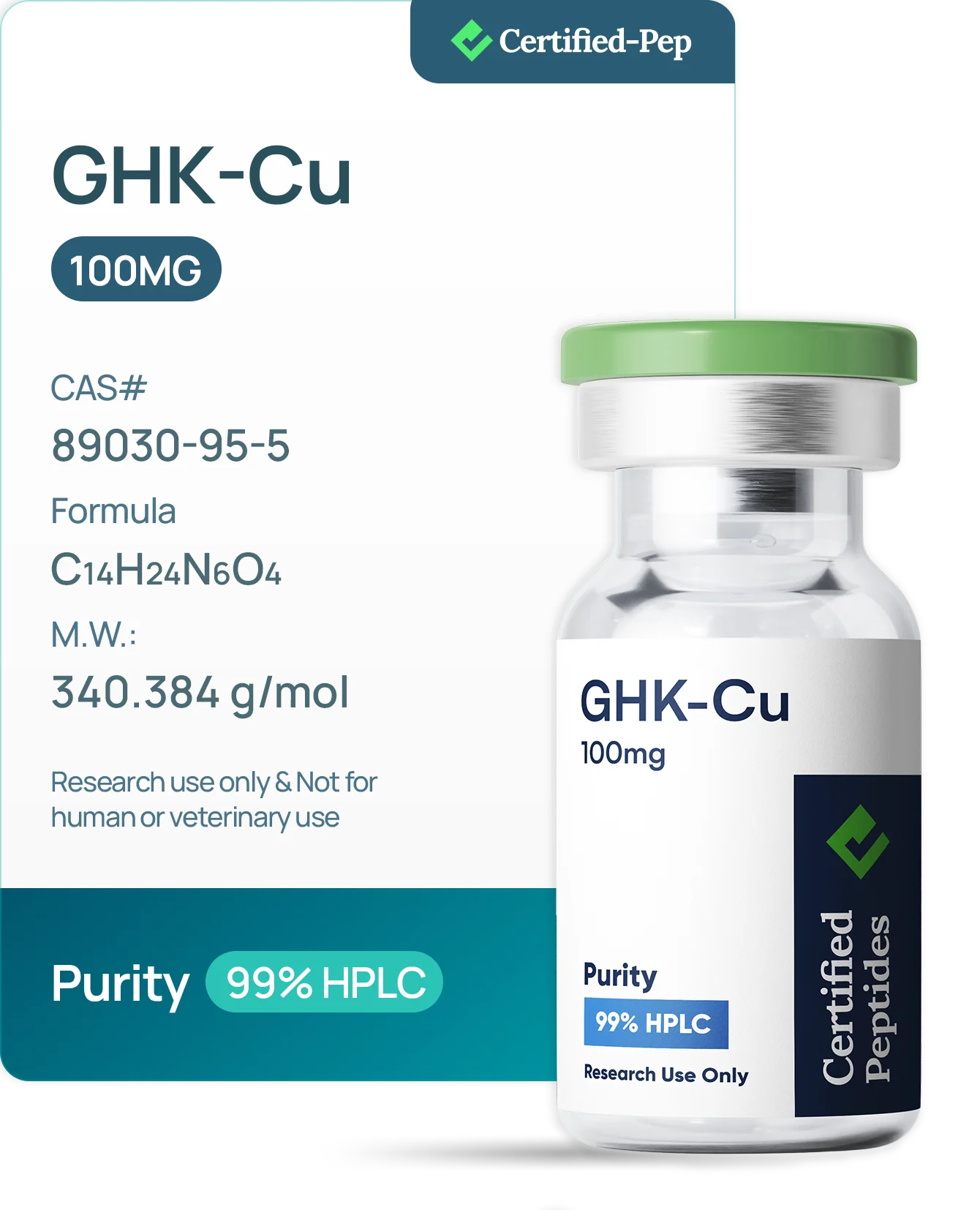
GHKCU 100 MG
USD 59.00
In stock
Last synced: 2026-09-17 09:48
Add to retailer cart ↗View product details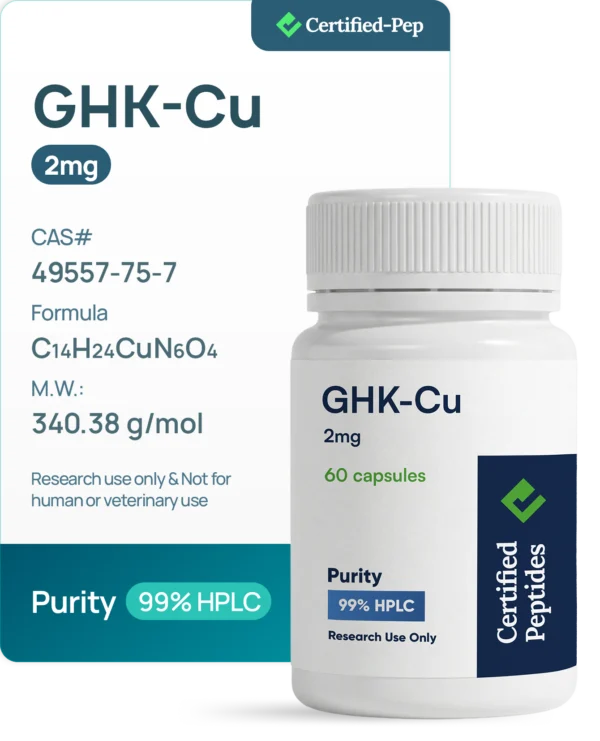
GHKCU 2MG 60 CAPSULES
USD 198.00
Out of stock
Last synced: 2026-09-17 09:48
View product ↗