
What does GHK-Cu research show about extracellular matrix biology?
GHK-Cu (glycyl-L-histidyl-L-lysine-copper) research demonstrates its ability to stimulate extracellular matrix (ECM) accumulation in animal models and modulate gene expression in cell lines. However, these findings are limited to preclinical contexts, and there is no direct evidence supporting the benefit or safety of retail GHK-Cu products, such as GHKCU 100 MG, in humans. All research products are for laboratory use only.
Direct Answer
GHK-Cu (glycyl-L-histidyl-L-lysine-copper) research indicates that this peptide-copper complex can stimulate extracellular matrix (ECM) accumulation, particularly collagen and glycosaminoglycans, in animal wound models and modulate gene expression related to ECM biology in cell lines. However, these effects are observed in controlled laboratory and animal studies, not in humans. The sources examined here do not establish benefit, safety, or efficacy of the retail product GHKCU 100 MG for human use. All findings are for research and educational purposes only, not medical advice or product endorsement.
What is GHK-Cu and Why Is It Studied in ECM Biology?
GHK-Cu is a naturally occurring tripeptide (glycyl-L-histidyl-L-lysine) that binds copper(II) ions, forming a complex with diverse biological activities. It was first identified as a growth factor in human plasma and has since been studied for its potential role in tissue repair, regeneration, and modulation of the extracellular matrix (ECM)—the network of proteins and polysaccharides that provides structural and biochemical support to surrounding cells. The ECM is crucial for wound healing, tissue integrity, and cellular communication. GHK-Cu’s ability to bind copper is thought to be central to its biological effects, as copper is an essential cofactor for enzymes involved in collagen cross-linking and antioxidant defense. Research interest in GHK-Cu stems from its observed effects on fibroblast activity, collagen synthesis, and gene expression in vitro and in animal models, making it a candidate for further investigation in ECM biology Source 1, Source 2.
What Do Rat Wound-Chamber Studies Reveal About GHK-Cu and ECM Accumulation?
A pivotal in vivo study used a rat wound-chamber model to assess GHK-Cu’s effects on ECM accumulation. Stainless steel mesh cylinders were implanted subcutaneously in rats, and the chambers were injected with either saline (control) or various concentrations of GHK-Cu. After a set period, the wound chamber contents were analyzed for dry weight, total protein, collagen, DNA, elastin, glycosaminoglycans, and specific mRNAs for collagens and TGF-beta. The results showed a concentration-dependent increase in dry weight, DNA, total protein, collagen, and glycosaminoglycan content in GHK-Cu-treated chambers. Notably, collagen synthesis was stimulated to a greater extent than non-collagen proteins, and both type I and type III collagen mRNAs were increased, while TGF-beta mRNAs were not. The study also found an increase in dermatan sulfate, a glycosaminoglycan associated with wound healing. Importantly, a control tripeptide (L-glutamyl-L-histidyl-L-proline) had no significant effect, supporting the specificity of GHK-Cu’s action Source 1.
How Does GHK-Cu Affect Collagen mRNA Versus Protein Accumulation?
The rat wound-chamber study measured both mRNA levels for type I and III collagen and the actual accumulation of collagen protein. GHK-Cu treatment led to increased mRNA levels for these collagens, suggesting upregulation at the transcriptional level. This was paralleled by a significant increase in collagen protein content in the wound chambers. The stimulation of collagen synthesis was approximately twice that of non-collagen proteins, indicating a selective effect on ECM components. However, while increased mRNA levels often predict increased protein synthesis, post-transcriptional and post-translational regulatory mechanisms can modulate this relationship. The study’s findings suggest that GHK-Cu enhances both the genetic and biochemical pathways leading to ECM protein accumulation, but these effects were observed in a controlled animal model, not in human tissue Source 1.
What Controls Were Used and What Do They Tell Us?
To ensure the observed effects were specific to GHK-Cu, the rat wound-chamber study included several controls. Saline-injected chambers served as negative controls, establishing baseline ECM accumulation in the absence of the peptide. Additionally, a structurally similar tripeptide (L-glutamyl-L-histidyl-L-proline) was used as a peptide control and did not produce significant changes in ECM accumulation. These controls strengthen the conclusion that the effects on ECM components were due to GHK-Cu rather than nonspecific peptide or injection effects. However, while these controls are appropriate for the animal model, they do not address potential differences in human biology or the effects of GHK-Cu in more complex tissue environments Source 1.
How Should Connectivity Map (cMap) Predictions Be Interpreted in ECM Research?
The Connectivity Map (cMap) is a computational tool that predicts how small molecules, such as GHK, might influence gene expression based on large-scale cell-line data. In studies using cMap, GHK was identified as a compound capable of reversing pathological gene expression patterns associated with tissue destruction and promoting those linked to tissue repair. For example, cMap predicted that GHK would reverse gene signatures associated with chronic obstructive pulmonary disease (COPD) and metastatic cancer, and laboratory experiments confirmed some of these predictions in cell cultures. However, cMap predictions are based on gene expression changes in specific human cell lines (e.g., PC3 prostate cancer and MCF7 breast cancer cells) and do not directly measure ECM protein synthesis or functional tissue outcomes. While cMap can guide hypothesis generation, its predictions require validation in relevant biological systems, and gene expression changes do not always translate to functional or clinical effects Source 2.
What Is the Difference Between GHK and GHK-Cu in ECM Studies?
GHK (glycyl-L-histidyl-L-lysine) is the peptide, while GHK-Cu denotes a copper complex of that peptide. This distinction matters when comparing experiments: a result reported for GHK in a gene-expression dataset should not automatically be described as a direct test of a particular GHK-Cu preparation. The 1993 rat experiment examined GHK-Cu in a specific wound-chamber model. The 2017 paper discusses GHK-related transcriptional data and wider mechanistic hypotheses. Neither source justifies treating every form, formulation, or commercial product as interchangeable. Researchers should check the identity of the material, experimental system and endpoint in each study rather than infer a universal ranking of activity. The catalog listing is product context, not a replication of these experiments Source 1, Source 2.
What Are the Limitations of Cell-Line and Animal Studies for ECM Research?
Most GHK-Cu research on ECM biology is conducted in vitro (cell cultures) or in animal models (e.g., rats). While these systems allow for controlled investigation of molecular mechanisms and biological effects, they have inherent limitations. Cell lines may not accurately represent the complexity of human tissues, as they often lack the full repertoire of cell types, extracellular matrix components, and physiological signaling found in vivo. Animal models, while more complex, may not fully recapitulate human wound healing or ECM dynamics due to species differences. Furthermore, dosing, metabolism, and tissue distribution of GHK-Cu in animals may not reflect human pharmacology. As a result, findings from these studies cannot be directly extrapolated to predict efficacy or safety in humans Source 1, Source 2.
Why Do These Studies Not Demonstrate Benefit of Retail GHK-Cu Products in Humans?
Despite promising preclinical findings, the two sources used for this explainer do not establish clinical benefit, safety, or efficacy of Certified Pep’s GHKCU 100 MG product. The evidence examined here concerns laboratory and animal models, which do not account for human-specific factors such as immune response, metabolism, and long-term safety. Retail products are intended for laboratory research only and are not approved for human or veterinary use. Claims of benefit, dosing, or therapeutic application are not supported by the current evidence base and should not be inferred from preclinical studies Source 1, Source 2.
What Are the Key Gaps and Uncertainties in GHK-Cu ECM Research?
Several important gaps remain in the understanding of GHK-Cu’s role in ECM biology:
- Lack of human clinical data: The sources reviewed here do not provide controlled human evidence establishing clinical outcomes for this retail product.
- Mechanistic uncertainty: While increased collagen mRNA and protein have been observed in animal models, the precise molecular pathways and long-term effects remain incompletely characterized.
- Translational limitations: Differences between animal, cell-line, and human biology may limit the applicability of preclinical findings.
- Product variability: The source studies did not test the listed retail product; its identity, formulation, and batch characteristics must not be assumed to match study materials.
These uncertainties underscore the need for further research before any clinical recommendations or product claims can be made Source 1, Source 2.
What Are the Key Takeaways for Researchers?
- GHK-Cu stimulates ECM accumulation, particularly collagen and glycosaminoglycans, in rat wound models and upregulates related gene expression in cell lines.
- GHK and GHK-Cu must be distinguished when interpreting the experimental material and outcomes.
- cMap predictions suggest broad gene expression effects but require biological validation.
- The findings discussed here do not establish human benefit, safety, or efficacy for the catalog product.
- Research products such as GHKCU 100 MG are for laboratory use only and not for human or veterinary application.
Evidence Limitations and Responsible Interpretation
This article uses a 1993 rat study and a 2017 gene-expression paper, not a systematic review of all current GHK-Cu evidence. The older study’s accessible HTML provides its abstract and references, while its full paper is supplied as a scanned PDF; conclusions here are limited to the retrieved text. Researchers should interpret findings cautiously, recognizing the limitations of animal and cell-line studies and the lack of product-specific clinical evidence in these sources. No claims regarding therapeutic benefit, safety, or regulatory approval are justified based on the available evidence. Any use of GHK-Cu should be confined to controlled laboratory research, and retail products should not be used in humans or animals outside of approved research protocols.
For research and educational purposes only. Not medical advice. Research products are not for human or veterinary use.
Sources
- In vivo stimulation of connective tissue accumulation by the tripeptide-copper complex glycyl-L-histidyl-L-lysine-Cu2+ in rat experimental wounds - PMC: https://pmc.ncbi.nlm.nih.gov/articles/PMC288419/
- The Effect of the Human Peptide GHK on Gene Expression Relevant to Nervous System Function and Cognitive Decline - PMC: https://pmc.ncbi.nlm.nih.gov/articles/PMC5332963/
Related reading
For more context, read GHK vs. GHK-Cu: What Is the Difference?.
TRACE THE EVIDENCE
Sources & further reading
RELATED PRODUCT INFORMATION
From the Certified Pep catalog.
Product references are informational, not a recommendation for human use. Prices and availability must be verified at retailer checkout.
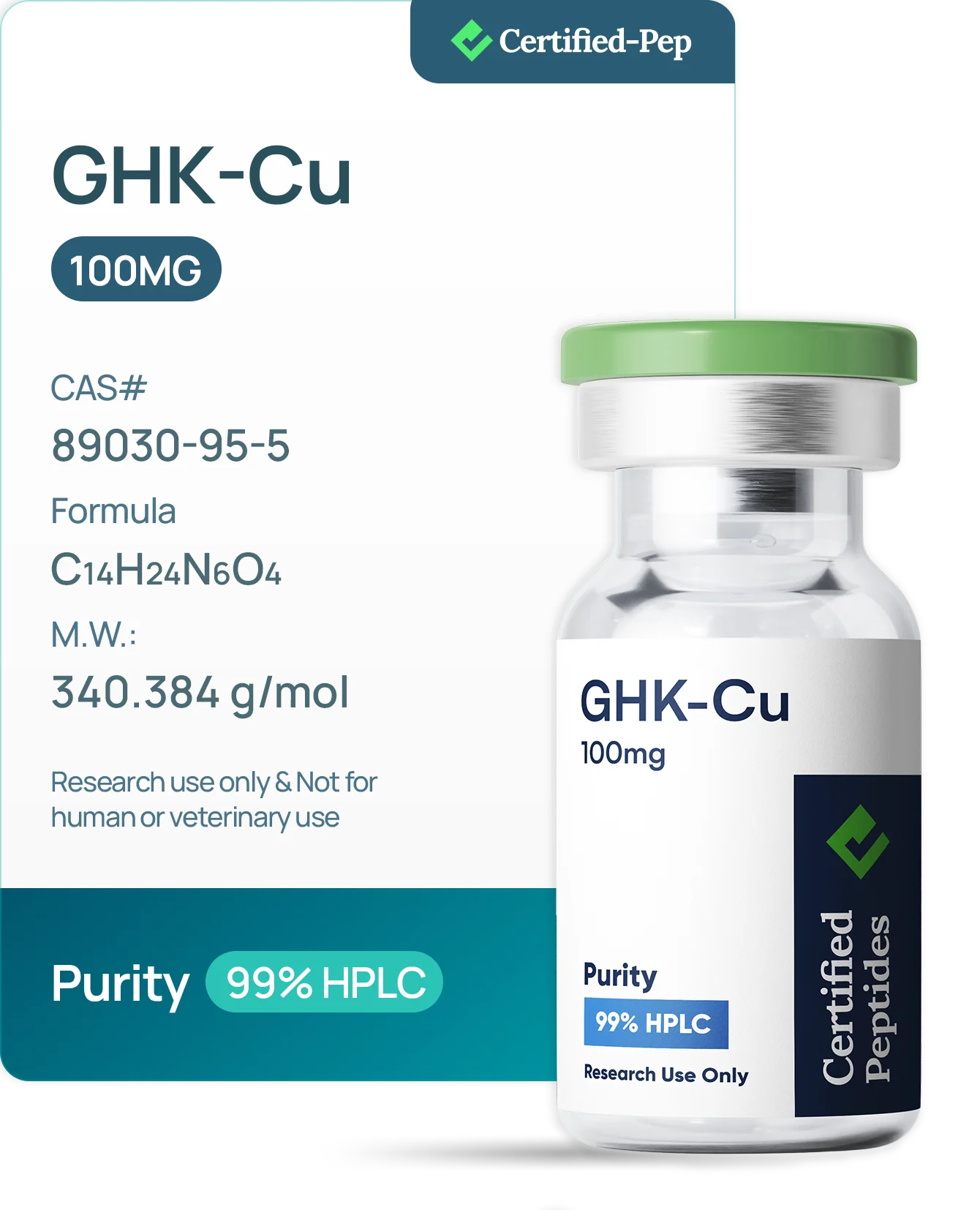
GHKCU 100 MG
USD 59.00
In stock
Last synced: 2026-09-17 09:48
Add to retailer cart ↗View product details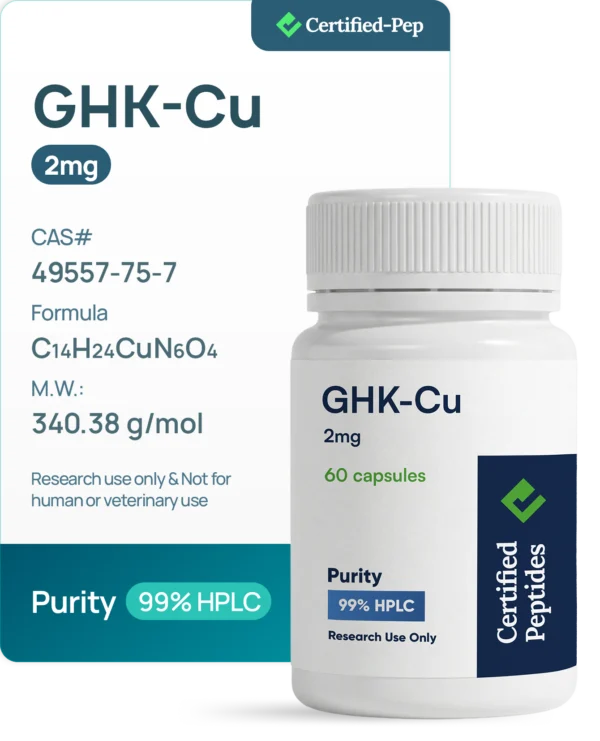
GHKCU 2MG 60 CAPSULES
USD 198.00
Out of stock
Last synced: 2026-09-17 09:48
View product ↗