
Semax Research: Copper, Oxidative Stress and Cell Studies
Explore Semax copper-binding and oxidative-stress experiments, what the biochemical and cell assays measured, and what they cannot establish about human health.

Direct Answer: What Do Copper and Oxidative-Stress Experiments Show About Semax?
Recent in vitro and cell-culture studies demonstrate that Semax, a synthetic peptide, can strongly bind copper(II) ions, inhibit copper-catalyzed reactive oxygen species (ROS) production, and reduce cytotoxicity in human neuroblastoma cells exposed to amyloid-beta (Aβ) and copper. These findings are limited to laboratory models and do not establish clinical efficacy, safety, or therapeutic benefit in humans. The research illuminates Semax’s biochemical interactions with copper and oxidative stress pathways but does not support clinical claims regarding dementia prevention, cognitive improvement, or disease treatment Source 1.
Research-Reading Checklist
- Model: In vitro biochemical assays and human neuroblastoma (SH-SY5Y) cell cultures
- Endpoints: Copper binding, ROS production, ascorbate consumption, cell viability, intracellular ROS
- Controls: Free copper, Aβ peptides, ascorbate, and known ROS inducers (e.g., H₂O₂)
- Mechanistic Focus: Metal ion chelation, redox silencing, ROS inhibition
- Limitations: No animal or human clinical data; results may not translate to in vivo systems
- No Clinical Claims: No evidence for disease prevention, cognitive enhancement, or safety in humans
- Product Context: Research-only; not for human or veterinary use
1. Background: Semax, Copper, and Oxidative Stress in Neurodegeneration
Semax (Met-Glu-His-Phe-Pro-Gly-Pro) is a synthetic peptide derived from the adrenocorticotropic hormone (ACTH) fragment. It is designed to retain neurotrophic activity without hormonal effects. The peptide’s relevance to neurodegenerative research stems from its high affinity for copper(II) ions and its potential to modulate oxidative stress, a key pathological feature in disorders such as Alzheimer’s disease (AD) Source 1.
Copper homeostasis is tightly regulated in the brain, but in AD, copper accumulates in amyloid plaques and can catalyze the production of ROS via redox cycling. This process, particularly when copper is bound to Aβ peptides, is implicated in neuronal damage. Strategies that chelate copper and silence its redox activity are of significant interest for understanding and potentially modulating neurodegenerative processes at the molecular level.
2. Biochemical Mechanisms: Semax as a Copper Chelator and Redox Silencer
Semax contains an ATCUN (Amino Terminal Cu(II) and Ni(II) binding) motif, conferring it with extremely high affinity for copper(II) ions (conditional Kd ≈ 1.3 × 10⁻¹⁵ M at pH 7.4). This enables Semax to outcompete Aβ peptides for copper binding. When Semax binds copper, it forms a highly stable, redox-inert complex, preventing copper from participating in redox cycling and subsequent ROS generation Source 1.
Experimental data show that Semax can extract copper from preformed Aβ:Cu(II) complexes, shifting the equilibrium toward redox silencing. This is evidenced by UV-Vis spectroscopy, where the addition of Semax to Aβ:Cu(II) complexes results in spectral shifts characteristic of the Semax:Cu(II) complex. Once copper is chelated by Semax, it is not readily transferred back to Aβ, indicating a strong binding under the tested conditions, without demonstrating irreversible binding in a biological system.
3. In Vitro Assays: Measuring ROS Production and Ascorbate Consumption
The primary biochemical endpoints in these studies are: - Ascorbate Consumption: Monitored by UV absorbance at 265 nm, reflecting the rate of ascorbate oxidation in the presence of copper and Aβ. - Hydroxyl Radical (•OH) Generation: Quantified using the coumarin-3-carboxylic acid (3-CCA) fluorescence assay, which detects the formation of fluorescent 7-hydroxycoumarin-3-carboxylate upon reaction with •OH.
In the absence of metal ions, ascorbate is stable. Free copper(II) rapidly catalyzes ascorbate oxidation and ROS production. When Aβ is present, copper binds to Aβ, moderating but not eliminating ROS production. The addition of Semax, either before or after Aβ:Cu(II) complex formation, significantly reduces both ascorbate consumption and •OH generation. This effect is attributed to Semax’s ability to chelate copper and prevent its redox cycling Source 1.
4. Kinetic and Thermodynamic Considerations: Limits of Redox Silencing
While Semax forms a highly stable Cu(II) complex, complete inhibition of ROS production is not always achieved. The interplay between kinetic and thermodynamic factors is critical: - Kinetics: Upon mixing, a fraction of Cu(II) may be reduced to Cu(I) by ascorbate before Semax can fully chelate the metal. Cu(I) can then form weaker complexes with Aβ, allowing some continued redox cycling and ROS production. - Thermodynamics: The Semax:Cu(II) complex is more stable than Aβ:Cu(II), but the reduction of Cu(II) to Cu(I) can outpace complex formation under certain conditions.
Experiments with bicinchoninic acid (BCA), a strong Cu(I) ligand, confirm that if Cu(II) is reduced before Semax binding, redox cycling and ROS generation can persist. However, preformed Semax:Cu(II) complexes are resistant to reduction and do not support ROS production, highlighting the importance of the sequence and timing of molecular interactions Source 1.
5. Cell-Culture Experiments: ROS and Cytotoxicity in SH-SY5Y Cells
To assess biological relevance, researchers exposed human neuroblastoma SH-SY5Y cells to copper, ascorbate, and Aβ, with or without Semax. Two main endpoints were measured: - Intracellular ROS: Detected using the H₂DCFDA probe and flow cytometry. Exposure to copper and ascorbate, especially with Aβ, markedly increased ROS-positive cells (up to ~79%). Semax co-treatment reduced this to ~40%. - Cell Viability: Assessed by MTT assay. Copper/ascorbate and copper/ascorbate/Aβ treatments reduced cell viability to ~59–63% of control. Semax co-treatment improved viability to ~82–83%.
These results suggest that Semax can mitigate copper-induced oxidative stress and cytotoxicity in this cell model, consistent with its biochemical redox-silencing properties Source 1.
6. Experimental Endpoints and Controls
Biochemical endpoints: - Ascorbate consumption (UV absorbance) - Hydroxyl radical generation (3-CCA fluorescence) - Copper binding (UV-Vis spectroscopy)
Cellular endpoints: - Intracellular ROS (H₂DCFDA fluorescence, flow cytometry) - Cell viability (MTT assay)
Controls: - Untreated cells (negative control) - H₂O₂-treated cells (positive control for ROS) - Ascorbate alone, copper alone, Aβ alone, and combinations thereof
These controls help evaluate whether observed effects are attributable to the specific interactions among copper, Aβ, and Semax, rather than nonspecific toxicity or assay artifacts.
7. Limitations and Unresolved Questions
- Model Limitations: All findings are from in vitro biochemical assays and immortalized cell lines. These models do not replicate the complexity of living organisms, blood-brain barrier dynamics, or long-term effects.
- No Animal or Human Data: This paper reports biochemical and cell-culture experiments, not animal treatment outcomes or human clinical trials; it does not establish the full scope of Semax research elsewhere.
- Kinetic Constraints: The effectiveness of Semax in silencing copper redox cycling depends on the timing and sequence of molecular interactions, which may differ in physiological environments.
- No Safety or Efficacy Data: The research does not address pharmacokinetics, toxicity, or therapeutic windows in humans or animals.
- No Disease Modification Evidence: The studies do not demonstrate prevention or reversal of neurodegenerative pathology, cognitive decline, or clinical outcomes.
8. Key Takeaways and Research-Only Context
- Semax is a potent copper(II) chelator with demonstrated ability to inhibit copper-catalyzed ROS production and cytotoxicity in vitro and in human neuroblastoma cell cultures.
- The peptide’s redox-silencing effect is robust but not absolute, with kinetic factors influencing outcomes in some experimental setups.
- These findings are mechanistic and limited to laboratory models; they do not establish clinical safety, efficacy, or therapeutic benefit for any disease or cognitive condition.
- Further research, including animal studies and controlled clinical trials, would be required to determine any potential translational relevance.
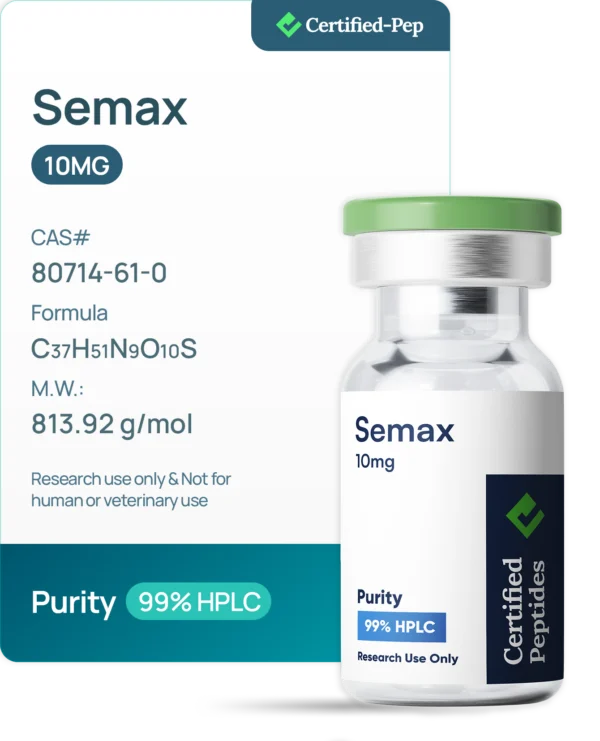
- The catalog Semax product shown here is presented for research use; this article does not verify approval status across countries or establish suitability for human or veterinary use.
References
- Semax, a Copper Chelator Peptide, Decreases the Cu(II)-Catalyzed ROS Production and Cytotoxicity of aβ by Metal Ion Stripping and Redox Silencing. https://pmc.ncbi.nlm.nih.gov/articles/PMC12151629/
For research and educational purposes only. Not medical advice. Research products are not for human or veterinary use.
How to interpret the cell measurements
SH-SY5Y is a cultured cell model, not a group of patients. The ROS-positive percentages and MTT signals reported here are assay outcomes under the paper’s conditions. They cannot be read as percentages of people helped, clinical risk reductions, or evidence that a retail Semax preparation reaches the brain. MTT measurements reflect the assay’s cellular metabolic response; translating that signal into claims about cognition would require very different experiments. The concentrations, exposure timing and controls belong to the laboratory model and are not a consumer-use protocol. These distinctions matter even when an experiment produces a statistically clear difference Source 1.
Continue exploring
TRACE THE EVIDENCE
Sources & further reading
RELATED PRODUCT INFORMATION
From the Certified Pep catalog.
Product references are informational, not a recommendation for human use. Prices and availability must be verified at retailer checkout.
SEMAX 10MG
USD 54.00
In stock
Last synced: 2026-09-17 09:48
Add to retailer cart ↗View product details