
Folic Acid Rescue in MOTS-c Cellular Experiments: Mechanistic Insights and Research Context
This resource examines the role of the folic acid rescue test in MOTS-c cellular experiments, focusing on mechanistic findings, experimental design, and the interpretation of results within the context of current peptide research. Evidence is drawn from controlled in vitro studies, with limitations and uncertainties clearly stated.

Direct Answer: What Does the Folic Acid Rescue Test in MOTS-c Cellular Experiments?
In cellular experiments investigating the mitochondrial-derived peptide MOTS-c, the folic acid rescue test is used to determine whether the metabolic effects of MOTS-c—specifically, its enhancement of glycolytic flux and suppression of mitochondrial respiration—are mediated through inhibition of the folate cycle. By supplementing cells with exogenous folic acid, researchers assess whether restoring folate cycle intermediates can reverse the metabolic changes induced by MOTS-c. The successful reversal of these effects upon folic acid supplementation provides mechanistic evidence that MOTS-c acts, at least in part, by depleting intracellular folate derivatives and thereby modulating cellular metabolism Source 1.
Introduction: MOTS-c and Cellular Metabolism
MOTS-c (mitochondrial open-reading-frame of the twelve S rRNA type-c) is a 16-amino acid peptide encoded within the mitochondrial 12S rRNA. It has been identified as a bioactive signaling molecule with regulatory roles in cellular metabolism, particularly in the context of insulin sensitivity and metabolic homeostasis. Initial studies have shown that MOTS-c can alter gene expression and metabolic pathways in cultured cells, with pronounced effects on glycolysis, mitochondrial respiration, and fatty acid metabolism. Understanding the precise mechanisms by which MOTS-c exerts these effects is a central focus of current peptide research Source 1.
Experimental Design: The Folic Acid Rescue Test
The folic acid rescue test is a targeted experimental approach used to dissect the mechanistic pathway through which MOTS-c influences cellular metabolism. In these experiments, researchers treat cultured cells (such as HEK293 or stably transfected cell lines overexpressing MOTS-c) with exogenous MOTS-c peptide. They then measure metabolic endpoints, including glycolytic rate (extracellular acidification rate, ECAR), oxygen consumption rate (OCR), and levels of key metabolites in the folate and purine biosynthesis pathways.
To test whether the observed metabolic effects are due to inhibition of the folate cycle, folic acid is added to the culture medium. If folic acid supplementation reverses the metabolic changes induced by MOTS-c, this supports the hypothesis that MOTS-c acts upstream of, or directly on, the folate cycle. This experimental design allows for a causal inference regarding the involvement of folate metabolism in MOTS-c’s cellular actions Source 1.
In Vitro Findings: MOTS-c, Folate Cycle, and Metabolic Modulation
In controlled in vitro studies, MOTS-c treatment led to a marked increase in glycolytic flux, as evidenced by enhanced ECAR, and a concomitant decrease in mitochondrial respiration (OCR). Metabolomic profiling revealed that MOTS-c reduced intracellular levels of 5-methyltetrahydrofolate (5Me-THF), the most abundant form of activated folate, and methionine, while increasing homocysteine. These changes were coupled with a blockade of de novo purine biosynthesis and a dramatic accumulation of the purine intermediate AICAR (5-aminoimidazole-4-carboxamide ribonucleotide), a known activator of AMP-activated protein kinase (AMPK).
Crucially, when folic acid was added to the culture medium, the enhanced glycolytic response and suppressed respiration induced by MOTS-c were fully reversed. This finding indicates that the metabolic effects of MOTS-c are dependent on its ability to deplete intracellular folate derivatives, thereby inhibiting the folate cycle and its downstream pathways Source 1.
Mechanistic Interpretation: What Does the Rescue Demonstrate?
The folic acid rescue test provides mechanistic evidence that MOTS-c’s metabolic actions are mediated through inhibition of the folate cycle. By restoring folate cycle intermediates with exogenous folic acid, researchers can reverse the metabolic phenotype induced by MOTS-c. This suggests that the depletion of 5Me-THF and related metabolites is a key step in the pathway by which MOTS-c enhances glycolysis and suppresses mitochondrial respiration.
Further, the accumulation of AICAR and activation of AMPK downstream of folate cycle inhibition links MOTS-c’s actions to well-characterized metabolic regulatory pathways. The rescue experiment thus serves as a functional validation of the proposed mechanism, distinguishing direct effects on the folate cycle from off-target or secondary effects Source 1.
Broader Context: MOTS-c, Folate Metabolism, and Cellular Energy Sensing
The folate cycle is central to one-carbon metabolism, supporting nucleotide biosynthesis, methylation reactions, and redox balance. Inhibition of this cycle, as seen with MOTS-c treatment, disrupts de novo purine synthesis and leads to the accumulation of AICAR, which in turn activates AMPK—a master regulator of cellular energy homeostasis. This pathway is also targeted by pharmacological agents such as methotrexate and metformin, which have overlapping metabolic effects.
The use of the folic acid rescue test in MOTS-c experiments situates this peptide within a broader network of metabolic regulation, highlighting the importance of mitochondrial-derived signals in cellular energy sensing and adaptation. However, these findings are currently limited to in vitro models and should not be extrapolated to organismal or clinical outcomes without further evidence Source 1.
Experimental Controls and Specificity
To ensure the specificity of the observed effects, researchers employed several controls in the MOTS-c cellular experiments. These included the use of null mutants (MOTS-c peptides with key residues substituted to alanine) and scrambled peptide sequences, both of which failed to reproduce the metabolic phenotype seen with wild-type MOTS-c. Additionally, knockdown of AMPK or SIRT1, or pharmacological inhibition of these pathways, partially attenuated the glycolytic effects of MOTS-c, further supporting the involvement of these signaling nodes.
The reversal of MOTS-c-induced metabolic changes by folic acid supplementation was specific and reproducible, strengthening the causal link between folate cycle inhibition and the observed cellular phenotype. These rigorous controls are essential for interpreting the mechanistic significance of the folic acid rescue test Source 1.
Limitations and Uncertainties
While the folic acid rescue test provides strong evidence for the involvement of the folate cycle in MOTS-c’s cellular actions, several limitations must be acknowledged:
- Model System: All findings are derived from in vitro experiments using immortalized cell lines (e.g., HEK293, HeLa, L6 myotubes). The relevance of these results to primary cells, tissues, or whole organisms remains to be established.
- Concentration and Exposure: The concentrations of MOTS-c and folic acid used in these experiments may not reflect physiological or pathophysiological conditions.
- Complexity of Folate Metabolism: The folate cycle is interconnected with multiple metabolic pathways, and the downstream consequences of its inhibition may vary depending on cellular context.
- Lack of In Vivo Rescue Data: There is currently no evidence that folic acid supplementation can reverse MOTS-c-induced metabolic effects in animal models or humans.
- No Clinical Implications: These findings do not establish safety, efficacy, or therapeutic potential of MOTS-c or folic acid in any disease context.
Further research is needed to validate these mechanisms in more physiologically relevant systems and to explore potential off-target effects or compensatory responses Source 1.
Key Takeaways and Research Gaps
- The folic acid rescue test in MOTS-c cellular experiments is a mechanistic tool to demonstrate that MOTS-c’s metabolic effects are mediated by inhibition of the folate cycle.
- Supplementation with folic acid reverses the enhanced glycolysis and suppressed respiration induced by MOTS-c, supporting a causal role for folate cycle depletion.
- These findings are robust in controlled in vitro models but have not been validated in vivo or in clinical settings.
- The broader implications for metabolic regulation and disease remain speculative and require further investigation.
- No dosing, administration, or clinical recommendations can be made based on current evidence.
Incidental Product Note
Research-use-only MOTS-c peptides are available from suppliers such as Certified-Pep (MOTS C 10MG, MOTS C 20MG, MOTS C 40MG). These products are intended strictly for laboratory research and are not for human or veterinary use. Product descriptions do not constitute scientific evidence or imply suitability for any application beyond controlled research.
Disclaimer
For research and educational purposes only. Not medical advice. Research products are not for human or veterinary use.
Sources
- The Mitochondrial-derived peptide MOTS-c promotes metabolic homeostasis and reduces obesity and insulin resistance. https://pmc.ncbi.nlm.nih.gov/articles/PMC4350682/
Continue exploring
TRACE THE EVIDENCE
Sources & further reading
RELATED PRODUCT INFORMATION
From the Certified Pep catalog.
Product references are informational, not a recommendation for human use. Prices and availability must be verified at retailer checkout.
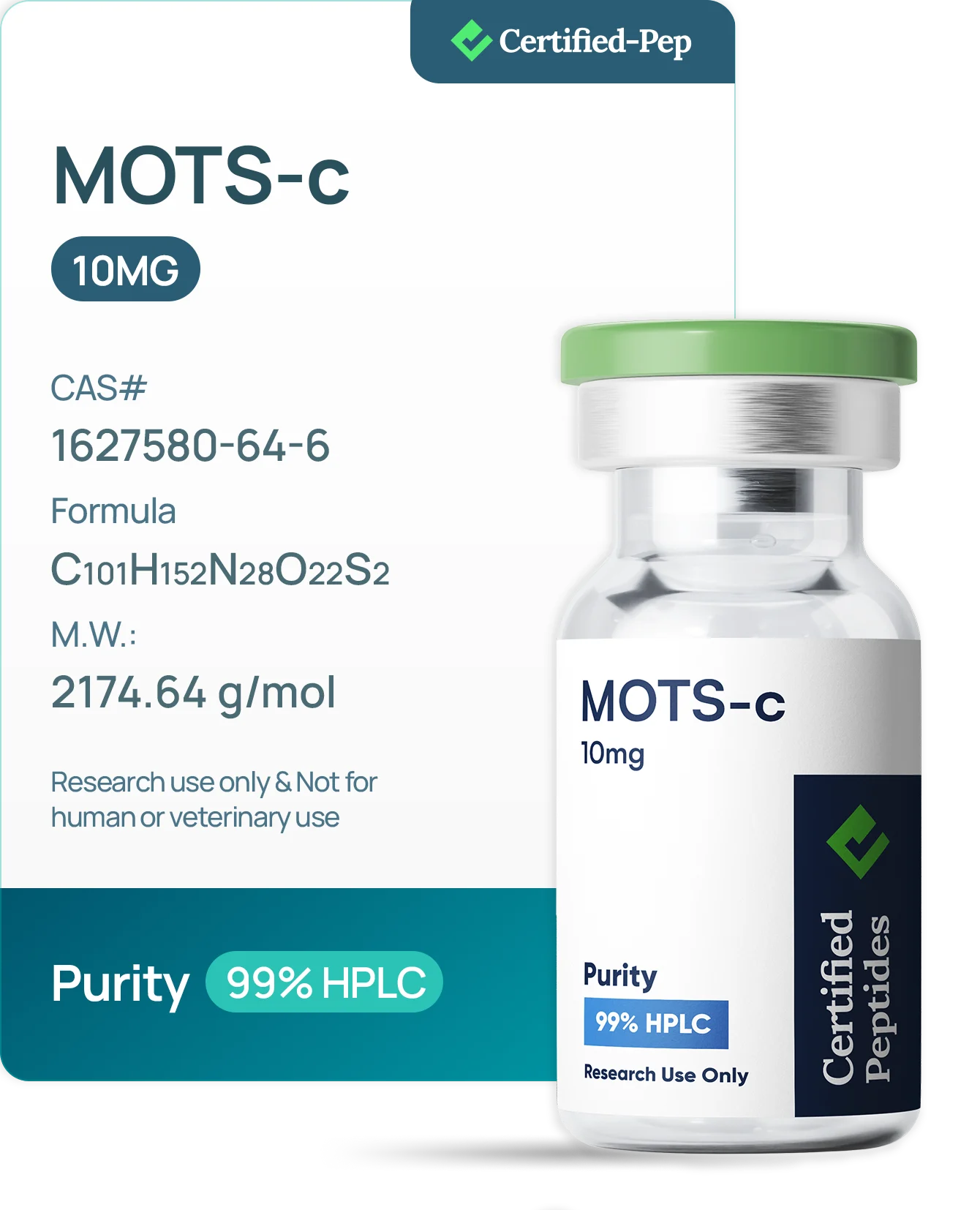
MOTS C 10MG
USD 58.00
In stock
Last synced: 2026-11-01 10:07
Add to retailer cart ↗View product details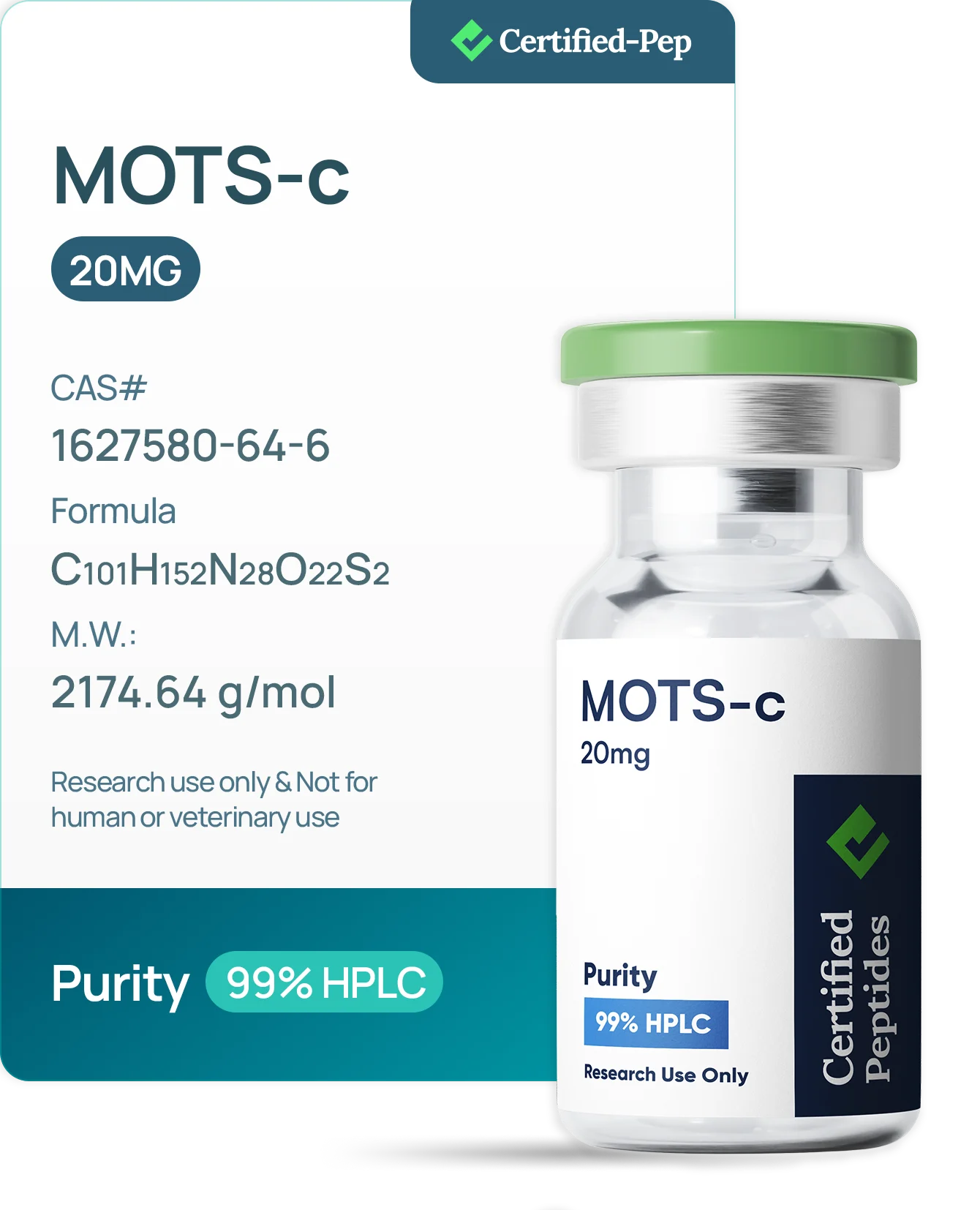
MOTS C 20MG
USD 90.00
In stock
Last synced: 2026-11-01 10:07
Add to retailer cart ↗View product details
MOTS C 40MG
USD 160.00
In stock
Last synced: 2026-11-01 10:07
Add to retailer cart ↗View product details