
The Role of Mutant and Scrambled Peptide Controls in MOTS-c Research: A Technical Analysis
Mutant and scrambled peptide controls are essential in MOTS-c studies to confirm specificity and rule out non-sequence-dependent effects. This article explains their use, interpretation, and limitations in the context of metabolic research.

Direct Answer: How Do Mutant and Scrambled Peptide Controls Support the MOTS-c Study?
In the foundational MOTS-c study, mutant and scrambled peptide controls were used to rigorously test whether observed cellular and metabolic effects were due to the specific amino acid sequence of MOTS-c, rather than generic peptide properties or experimental artifacts. These controls demonstrated that only the native MOTS-c sequence produced the reported metabolic effects, supporting the conclusion that MOTS-c’s actions are sequence-specific and not attributable to non-specific peptide activity. This strengthens the internal validity of the study’s findings, but does not by itself establish clinical relevance or safety in humans Source 1.
Introduction: Understanding Peptide Controls in Experimental Design
Peptide research, particularly involving novel bioactive sequences like MOTS-c (mitochondrial open-reading-frame of the twelve S rRNA type-c), requires stringent experimental controls to distinguish true biological activity from background noise or non-specific effects. Two widely used controls are mutant peptides—where specific residues are altered—and scrambled peptides, which retain the same amino acid composition but in a randomized order. These controls are critical for interpreting whether a peptide’s effects are due to its unique sequence and structure, or simply a result of generic peptide properties such as charge, hydrophobicity, or cellular uptake.
In the context of MOTS-c research, the use of these controls is particularly important given the peptide’s proposed role in regulating metabolic homeostasis, insulin sensitivity, and energy metabolism. Without such controls, it would be difficult to attribute observed effects to MOTS-c itself, rather than to experimental artifacts or peptide-related confounders Source 1.
Defining Mutant and Scrambled Peptide Controls
Mutant Peptide Controls
A mutant peptide is a version of the native peptide in which one or more amino acids are substituted, typically at conserved or functionally critical positions. In the MOTS-c study, two mutants were created by substituting glutamic acid at position 5 (E5A) and glycine at position 7 (G7A) with alanine. These positions were chosen based on evolutionary conservation and evidence of positive selection, suggesting their importance for biological activity Source 1.
Scrambled Peptide Controls
A scrambled peptide control has the same amino acid composition as the native peptide but with the sequence order randomized. This disrupts any secondary or tertiary structure and eliminates sequence-specific interactions, while controlling for overall peptide properties such as length, charge, and hydrophobicity. In the MOTS-c study, a scrambled peptide (M3S1) was generated that did not share primary sequence homology with any known proteins or peptides Source 1.
Experimental Application in the MOTS-c Study
Cellular Metabolism Assays
The MOTS-c study used both mutant and scrambled controls in assays measuring glycolytic flux and oxygen consumption in HEK293 cells. When cells were treated with native MOTS-c, there was a significant enhancement in glycolytic response to glucose stimulation, as measured by extracellular acidification rate (ECAR). In contrast, cells treated with either the E5A or G7A mutants, or with the scrambled peptide, did not show this enhanced glycolytic response Source 1.
Specificity of Observed Effects
Similarly, the scrambled peptide failed to induce the decrease in oxygen consumption rate (OCR) observed with native MOTS-c. These findings indicate that the metabolic effects are not due to generic peptide properties, but are dependent on the specific sequence and structure of MOTS-c Source 1.
Interpretation: What Do These Controls Prove?
Sequence-Specific Activity
The lack of effect from mutant and scrambled controls provides strong evidence that the observed biological activities are sequence-specific. This is a critical distinction in peptide research, as many peptides can have non-specific effects on cells due to their physicochemical properties. The controls help rule out the possibility that the results are due to peptide uptake, charge interactions, or other non-sequence-dependent mechanisms.
Exclusion of Experimental Artifacts
By including these controls, the researchers also reduce the likelihood that their findings are due to experimental artifacts such as contamination, batch effects, or off-target interactions. The controls serve as negative comparators, strengthening the causal inference that the native MOTS-c sequence is responsible for the observed metabolic changes Source 1.
Checklist for Interpreting Peptide Control Experiments
- Are the controls structurally similar to the native peptide except for the intended changes?
- Mutant controls should only differ at targeted residues.
-
Scrambled controls should maintain amino acid composition but disrupt sequence order.
-
Are the controls tested under identical experimental conditions?
-
Controls and native peptide must be administered at the same concentration, time, and in the same cell or animal model.
-
Do the controls lack the biological activity observed with the native peptide?
-
Absence of effect in controls supports sequence-specificity.
-
Are the results reproducible across multiple assays or endpoints?
-
Consistent findings across glycolytic flux, oxygen consumption, and other metabolic endpoints strengthen conclusions.
-
Is there evidence that the controls do not interfere with assay readouts?
- Controls should not produce off-target effects that could mask or mimic the native peptide’s activity.
Limitations and Uncertainties
Model System Constraints
The MOTS-c study’s use of mutant and scrambled controls provides strong internal validity for the reported in vitro findings. However, these results are limited to the specific cell lines and animal models used. The controls do not address potential species differences, off-target effects in other tissues, or long-term consequences of peptide administration.
Lack of Human Data
While the controls confirm sequence-specific activity in cell and mouse models, they do not provide information about safety, efficacy, or mechanism in humans. Extrapolation to clinical relevance is not supported by these controls alone, and further research is required to determine whether similar specificity and effects occur in human physiology Source 1.
Potential for Unrecognized Off-Target Effects
Although mutant and scrambled controls are designed to rule out non-specific effects, they cannot account for all possible off-target interactions, especially in complex biological systems. There may be unknown pathways or receptors that respond differently to the controls versus the native peptide.
Technical Considerations
The design of mutant and scrambled controls must be carefully considered. For example, mutations should not disrupt peptide stability or cellular uptake unless that is the intended variable. Scrambled sequences should be checked for unintended homology to endogenous proteins or bioactive motifs.
Broader Context: The Importance of Rigorous Controls in Peptide Research
The use of mutant and scrambled peptide controls is a standard best practice in peptide research, particularly when investigating novel bioactive sequences. These controls are essential for:
- Validating specificity: Demonstrating that effects are due to the intended sequence.
- Ensuring reproducibility: Allowing other researchers to replicate findings with confidence.
- Facilitating mechanistic studies: Enabling the dissection of structure-activity relationships.
In the MOTS-c study, these controls were instrumental in establishing the peptide’s role in regulating metabolic pathways, providing a foundation for further mechanistic and translational research Source 1.
Reader Questions for Critical Appraisal
- How were the mutant and scrambled peptides validated for purity and sequence integrity?
- Were the controls tested for stability and cellular uptake compared to native MOTS-c?
- Are there additional controls (e.g., vehicle, unrelated peptides) that could further strengthen the conclusions?
- How might the choice of mutation sites affect the interpretation of results?
- What are the implications if a scrambled or mutant control shows partial activity?
Evidence Limitations and Key Takeaways
- Scope of Evidence: The findings regarding mutant and scrambled controls are limited to the experimental models and endpoints reported in the cited MOTS-c study. They do not establish clinical efficacy, safety, or regulatory approval.
- Translational Gaps: No human studies were cited; thus, the relevance of these controls to human biology remains untested.
- Experimental Rigor: The use of these controls strengthens the internal validity of the study but does not eliminate all sources of bias or confounding.
- Future Directions: Additional research is needed to explore the structure-activity relationship of MOTS-c in diverse models and to assess potential off-target effects or long-term outcomes.
Conclusion
Mutant and scrambled peptide controls are indispensable tools in peptide research, providing a robust framework for distinguishing sequence-specific effects from non-specific or artifactual findings. In the MOTS-c study, these controls demonstrated that the metabolic effects observed in vitro and in animal models were attributable to the unique sequence of MOTS-c, rather than to generic peptide properties. While this supports the specificity of MOTS-c’s actions in the reported experimental contexts, it does not establish clinical relevance or safety in humans. Careful interpretation and further research are required to translate these findings into broader biological or therapeutic insights.
Sources
- The Mitochondrial-derived peptide MOTS-c promotes metabolic homeostasis and reduces obesity and insulin resistance. https://pmc.ncbi.nlm.nih.gov/articles/PMC4350682/
For research and educational purposes only. Not medical advice. Research products are not for human or veterinary use.
Continue exploring
TRACE THE EVIDENCE
Sources & further reading
RELATED PRODUCT INFORMATION
From the Certified Pep catalog.
Product references are informational, not a recommendation for human use. Prices and availability must be verified at retailer checkout.
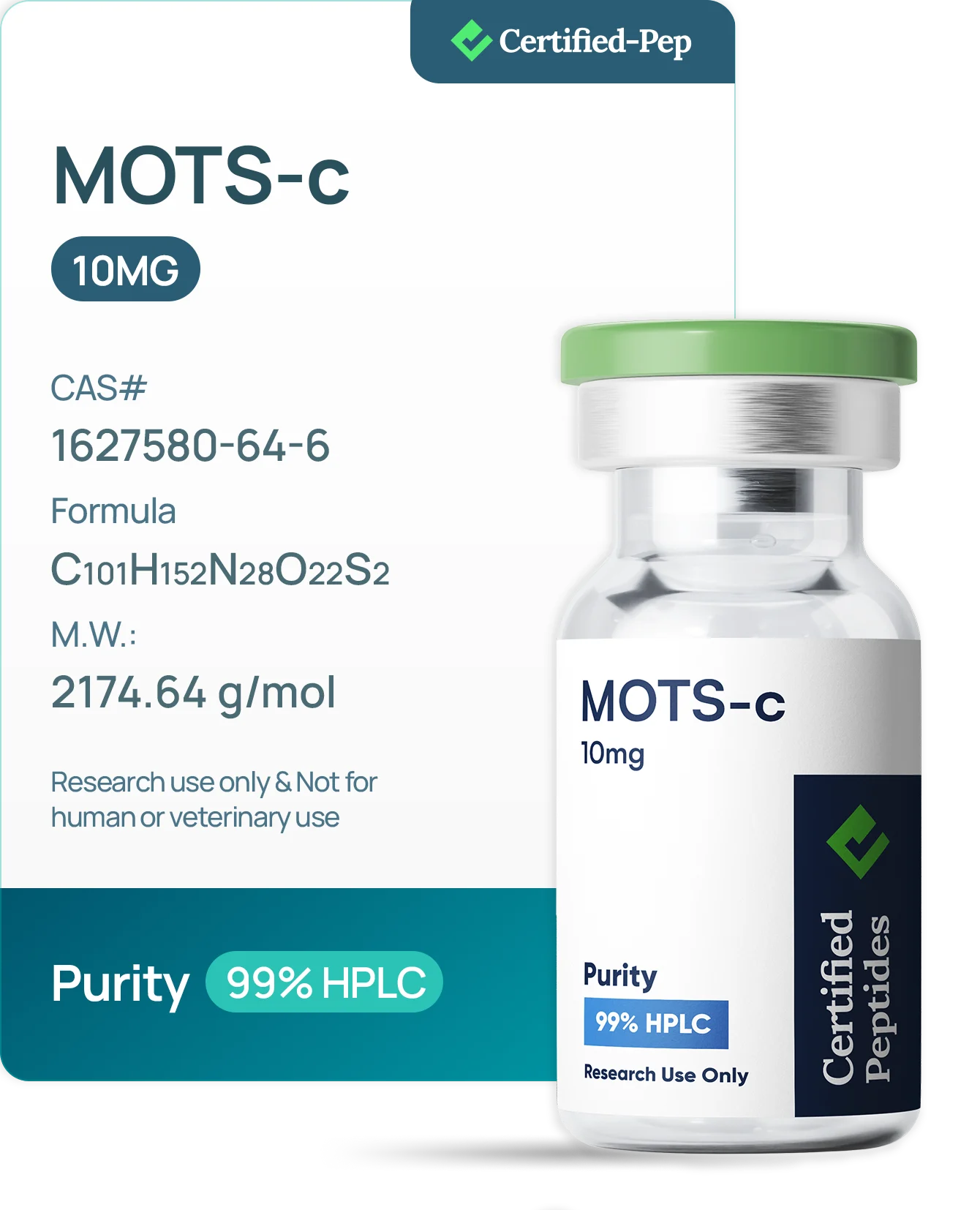
MOTS C 10MG
USD 58.00
In stock
Last synced: 2026-11-01 10:07
Add to retailer cart ↗View product details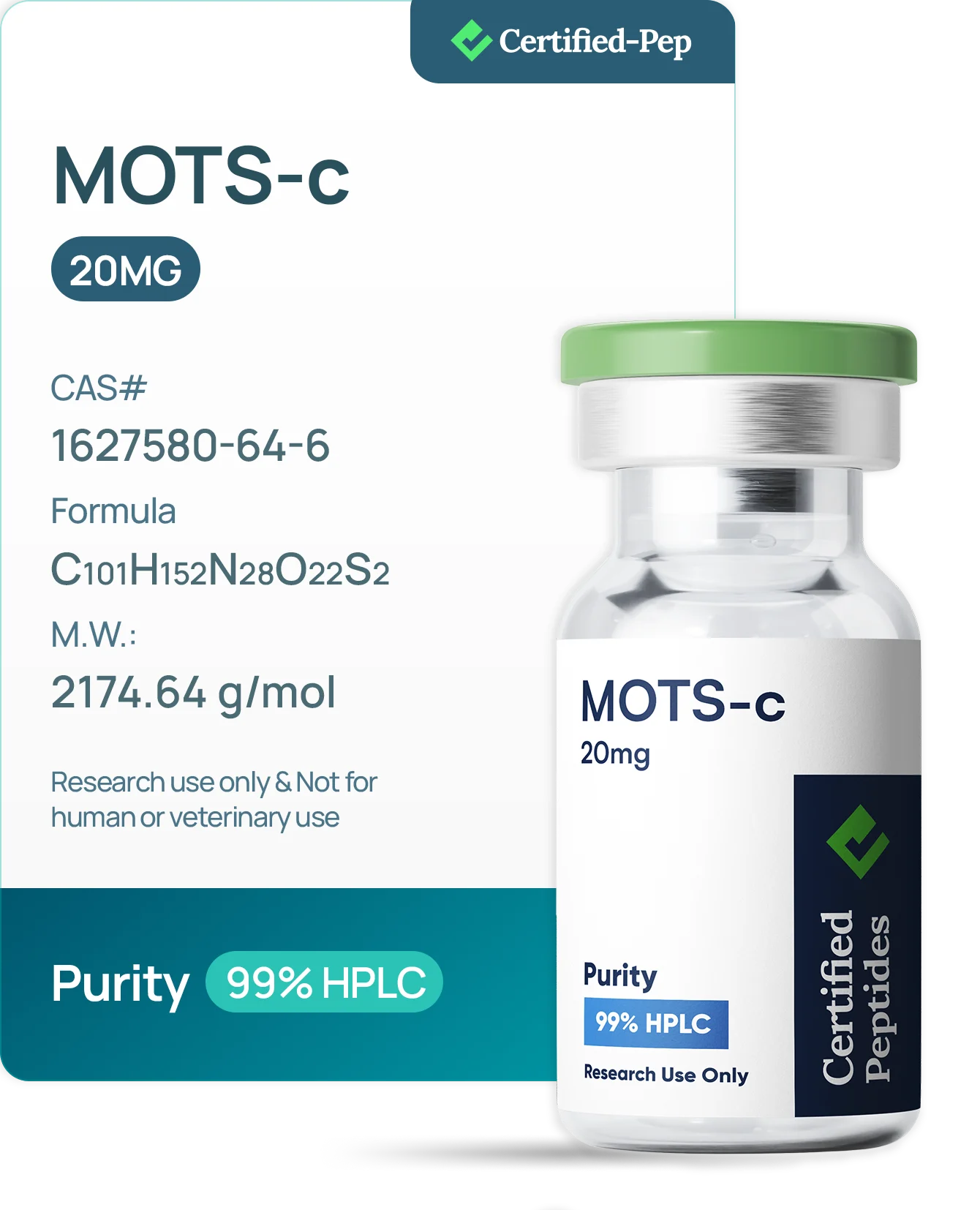
MOTS C 20MG
USD 90.00
In stock
Last synced: 2026-11-01 10:07
Add to retailer cart ↗View product details
MOTS C 40MG
USD 160.00
In stock
Last synced: 2026-11-01 10:07
Add to retailer cart ↗View product details
TB-500 10 MG
USD 70.00
In stock
Last synced: 2026-11-01 10:07
Add to retailer cart ↗View product details