
TB-500 Research: Identity, Metabolism and Evidence Limits
Explore TB-500 identity and metabolism studies, how the studied fragment differs from thymosin beta-4, and why laboratory findings do not prove human benefits.

Direct Answer: What Do Identity and Metabolism Studies Show for TB-500 (Ac-LKKTETQ)?
Recent research abstracts provide insight into the analytical identification and metabolic fate of TB-500, a synthetic peptide corresponding to the N-acetylated sequence Ac-LKKTETQ, which is derived from the active site of full-length thymosin beta-4 (Tβ4). These studies focus on the detection, quantification, and metabolic profiling of TB-500 and its breakdown products in in-vitro systems and animal models. They also highlight that the biological activities attributed to TB-500 in literature may be more closely associated with specific metabolites, particularly Ac-LKKTE, rather than the parent peptide itself. Importantly, these studies do not address clinical outcomes or provide evidence for safety or efficacy in humans. Furthermore, they distinguish TB-500 (Ac-LKKTETQ) from the full-length Tβ4 protein, emphasizing the need for precise terminology and analytical validation in peptide research Source 1 Source 2.
Understanding TB-500 and Its Relationship to Thymosin Beta-4
Defining TB-500 and Ac-LKKTETQ
In the two abstracts reviewed here, TB-500 denotes the N-acetylated heptapeptide Ac-LKKTETQ; a retail product name alone does not establish that identity. This sequence is derived from the actin-binding region of thymosin beta-4 (Tβ4), the parent peptide discussed as the source of this sequence. TB-500 is not the full-length Tβ4 protein, but rather a fragment designed to mimic some of its biological activities in research settings.
Distinguishing TB-500 from Full-Length Tβ4
The distinction between TB-500 (Ac-LKKTETQ) and full-length Tβ4 is critical for interpreting research. While Tβ4 contains the LKKTETQ motif, it also possesses additional amino acid sequences that may confer unique structural and functional properties. Research on TB-500 should not be extrapolated to the full-length protein without direct comparative studies. The abstracts reviewed here focus exclusively on the synthetic fragment and its metabolites, not on the entire Tβ4 molecule Source 1.
Analytical Identification of TB-500 and Its Metabolites
Mass Spectrometry-Based Methods
Both reviewed abstracts describe the use of advanced mass spectrometry (MS) techniques for the identification and quantification of TB-500 and its metabolites. One study utilized ultra-high-performance liquid chromatography coupled with Q-Exactive Orbitrap MS/MS to simultaneously analyze TB-500 and its breakdown products in in-vitro systems and rat urine Source 1. Another study applied high-resolution MS to detect N-acetylated LKKTETQ and its metabolites in horse plasma following administration Source 2.
Importance of Authentic Standards
A key methodological advance highlighted is the use of synthesized authentic standards for both TB-500 and its metabolites. This approach allows for more accurate structural identification and quantification, reducing the risk of misidentification that can occur when relying solely on predicted mass or immunoaffinity methods. For readers comparing these experiments with catalog products, the editorial implication is that a product name is not independent chemical verification; the abstracts do not assess this retailer Source 1.
Metabolic Fate of TB-500: In-Vitro and Animal Model Findings
Primary and Long-Term Metabolites
The metabolism of TB-500 was investigated in human serum, various in-vitro enzyme systems, and in rats. The primary metabolite identified was Ac-LK, which reached the highest concentration in rat urine within 0–6 hours post-administration. Ac-LKK was detected as a long-term metabolite, persisting up to 72 hours. These findings suggest that TB-500 undergoes sequential enzymatic cleavage, producing shorter peptide fragments over time Source 1.
Detection in Equine Models
In horses, N-acetylated LKKTETQ and its metabolite N-acetylated LK were detected in plasma following subcutaneous administration of TB-500. This demonstrates the applicability of the analytical methods across species and highlights the importance of monitoring both parent peptide and metabolites in doping control and pharmacokinetic studies Source 2.
Biological Activity of TB-500 and Its Metabolites: In-Vitro Evidence
Wound Healing and Cytotoxicity Assays
The reviewed research evaluated the biological activity of TB-500 and its metabolites using in-vitro wound healing and cytotoxicity assays in fibroblast cultures. Notably, neither the parent peptide nor its metabolites exhibited cytotoxicity in these assays. However, only the metabolite Ac-LKKTE demonstrated significant wound healing activity compared to controls. This finding suggests that the biological effects previously attributed to TB-500 in the literature may be mediated by specific metabolites rather than the parent compound itself Source 1.
Implications for Mechanistic Understanding
These results underscore the importance of considering peptide metabolism when interpreting in-vitro activity data. The presence of active metabolites may confound attribution of observed effects to the administered parent peptide. Further research is needed to elucidate the mechanisms by which these metabolites exert their effects and to determine their relevance in vivo.
Analytical Challenges and Method Validation
Extraction and Detection Techniques
The abstracts highlight the challenges associated with extracting and detecting small peptides from complex biological matrices. Immunoaffinity purification, while effective, may be limited by the availability and cost of specific antibodies. Alternative approaches, such as mixed-mode anion exchange solid-phase extraction, offer a more accessible means of isolating peptides for MS analysis Source 2.
Method Validation Parameters
The equine plasma abstract reports validation for specificity, precision and recovery, and estimated detection limits below 50 pg/mL for its seven target peptides. Those method-specific figures should not be attributed to the separate rat metabolism experiment. The use of high-resolution MS allows for retrospective data analysis, enabling the identification of previously uncharacterized metabolites or related peptides.
Practical Reading Checklist: Interpreting Peptide Identity and Metabolism Studies
- Clarify the Peptide Entity: Is the study examining a synthetic fragment (e.g., Ac-LKKTETQ) or a full-length protein (e.g., Tβ4)?
- Assess Analytical Methods: Are authentic standards and validated MS techniques used for identification and quantification?
- Distinguish Parent Compound from Metabolites: Are biological effects attributed to the administered peptide or its breakdown products?
- Review Experimental Models: Are findings from in-vitro, animal, or human studies? Avoid extrapolating across models without supporting evidence.
- Check for Method Validation: Are specificity, sensitivity, and recovery parameters reported?
- Beware of Retailer Claims: Product naming or labeling does not confirm chemical identity or research quality.
- Look for Activity Assays: Are functional assays (e.g., wound healing, cytotoxicity) included, and what endpoints are measured?
- Note Study Limitations: Are sample sizes, controls, and statistical analyses reported? Abstracts may omit critical details.
Reader Questions: Navigating the Evidence
- How do I know if a study is about TB-500 or full-length Tβ4?
- Check the peptide sequence and terminology. The reviewed papers use TB-500 for Ac-LKKTETQ, not the entire Tβ4 peptide. Verify the sequence in each new study or product document.
- Can I assume biological effects seen in vitro will occur in vivo?
- No. In-vitro findings may not translate to animal or human systems due to differences in metabolism, distribution, and complexity.
- Does detection of a peptide in plasma confirm its activity?
- Detection confirms presence, not biological activity. Functional assays are required to assess effects.
- Are retailer claims about peptide identity reliable?
- A retail name alone is insufficient verification. Evaluate the underlying analytical documentation rather than assuming the label establishes identity or that every retailer claim is false.
Limitations and Gaps in the Current Evidence
Abstract-Only Data
The evidence reviewed is limited to research abstracts, which provide concise summaries but often lack methodological detail, sample sizes, statistical analyses, and full experimental context. As such, interpretations must be cautious and avoid overgeneralization.
Lack of Human Clinical Data
Neither abstract reports controlled human studies or clinical outcomes. All findings are derived from in-vitro experiments or animal models (rats and horses). No conclusions about safety, efficacy, or therapeutic potential in humans can be drawn from these data.
Metabolite Activity Uncertainty
While Ac-LKKTE showed significant wound healing activity in vitro, the relevance of this finding to in-vivo or clinical settings remains unestablished. The metabolic pathways and biological effects of other metabolites, such as Ac-LK and Ac-LKK, require further investigation.
Analytical Method Constraints
Although advanced MS techniques offer high sensitivity and specificity, their accessibility and reproducibility across laboratories may vary. The abstracts do not provide detailed protocols or inter-laboratory validation data.
Key Takeaways for Research-Only Peptide Evidence
- TB-500 (Ac-LKKTETQ) is a synthetic peptide fragment derived from the active site of thymosin beta-4, not the full-length protein.
- Analytical identification and quantification of TB-500 and its metabolites require validated mass spectrometry methods and authentic standards.
- In animal models, TB-500 is rapidly metabolized to shorter peptides, with Ac-LK as the primary early metabolite and Ac-LKK as a long-term metabolite.
- In-vitro assays suggest that the metabolite Ac-LKKTE, rather than TB-500 itself, may be responsible for observed wound healing activity.
- No cytotoxicity was observed for TB-500 or its metabolites in fibroblast cultures.
- The reviewed studies do not provide evidence for human safety, efficacy, or clinical application.
- Retailer product names and descriptions do not substitute for rigorous analytical verification of peptide identity.
- Abstract-only evidence is inherently limited; full-text studies and independent replication are needed for robust conclusions.
Sources
- Simultaneous quantification of TB-500 and its metabolites in in-vitro experiments and rats by UHPLC-Q-Exactive orbitrap MS/MS and their screening by wound healing activities in-vitro. https://pubmed.ncbi.nlm.nih.gov/38382158/
- Doping control analysis of seven bioactive peptides in horse plasma by liquid chromatography-mass spectrometry. https://pubmed.ncbi.nlm.nih.gov/23318763/
For research and educational purposes only. Not medical advice. Research products are not for human or veterinary use.
Continue exploring
TRACE THE EVIDENCE
Sources & further reading
RELATED PRODUCT INFORMATION
From the Certified Pep catalog.
Product references are informational, not a recommendation for human use. Prices and availability must be verified at retailer checkout.
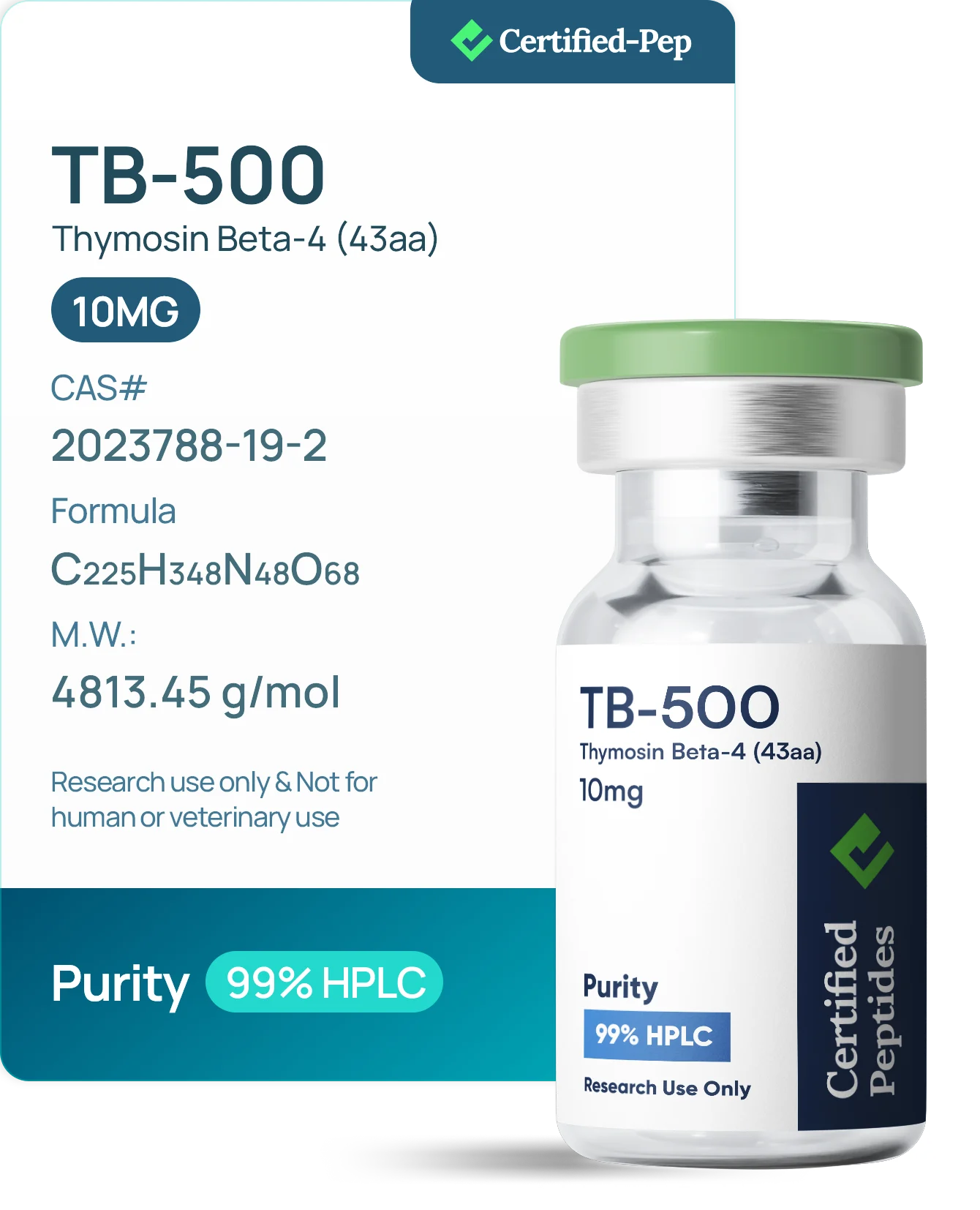
TB-500 10 MG
USD 70.00
In stock
Last synced: 2026-09-17 09:48
Add to retailer cart ↗View product details